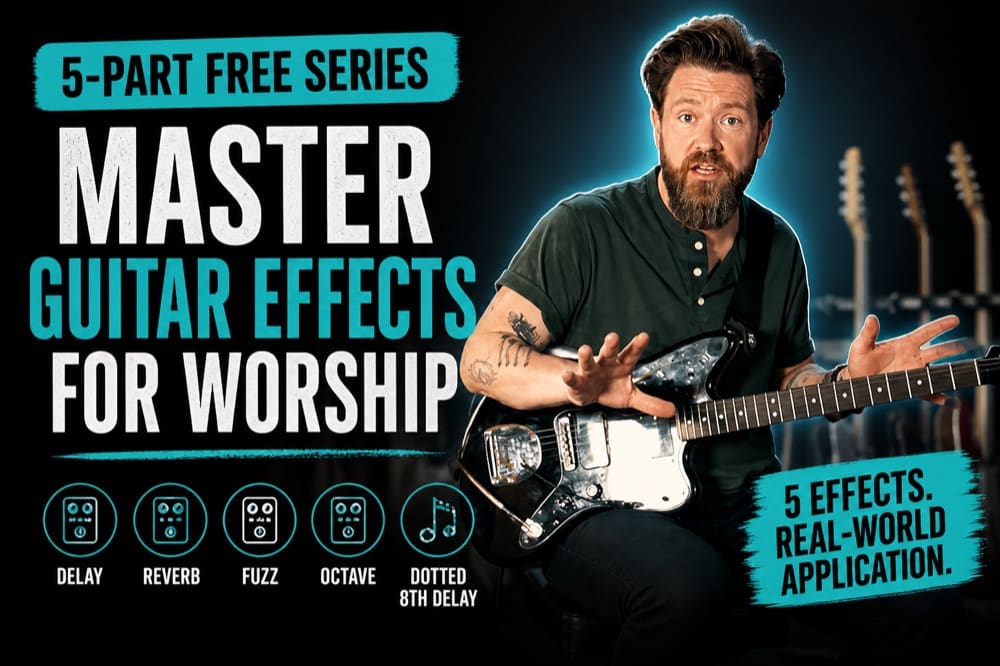

Want better tones from the pedals you already own? Watch the free 5-part worship guitar effects series.
In a previous blog post, I outlined some basic shapes that would empower guitarists of any skill level to be able to play rhythm in any key.
In this post, I want to outline some more “advanced”, for lack of a better term, chord shapes that I use frequently in my playing. For the sake of time, I want to stay within the keys of D and G. They are both common keys that are significant steps apart, can apply to many other keys when transposed or using a capo, and every open string in standard tuning can be utilized.
For each chord, I will show a variety of chords that I play on top of the base chord in the progression. My choice of a chord always varies depending on the song, part, and chords that are paired with them.
I’m not going to get into the technicalities of the names of each chord as I am going to assume that you already know the theory around that. If you don’t, you can still use these shapes in your playing and make decisions based on what sounds good to you.
With the chord options, I will simply place the corresponding Nashville number above.
If Nashville numbers are new to you, here is what each number means in these two keys:
| Number | Key of D | Key of G |
|---|---|---|
| 1 | D | G |
| 2 | Em | Am |
| 3 | F#m | Bm |
| 4 | G | C |
| 5 | A | D |
| 6 | Bm | Em |
A number after a slash, like 1/3, means the 1 chord with the 3 in the bass. In D, that is D/F#.
Why the keys of D and G?
Two reasons. First, they are two of the most common keys in worship music. Second, with a capo you can use these shapes in almost any key. Need the key of F? Capo 3 and play D shapes. Need C? Capo 5 and play G shapes.
There is one more benefit. Every open string on the guitar (E, A, D, G and B) is a note in both keys. That gives you a lot of open-string options that ring out under the chords.
One warning: do not live in these two keys. Practice in keys you are not used to as well. Each key has its own voicings, and stretching yourself changes how you think about the neck.
Start with the open chords
In the key of D, you can play every chord in the key without moving your hand far from the open D chord. A few small changes make those open chords sound less stock:
- Mute what you don’t play. A lot of good chord playing is about the strings you leave out. Wrap your thumb over the top of the neck, or let a fretting finger lean on the string next to it. For example, when I add the 2nd fret on the A string under the D shape, that same finger mutes the open D string.
- Add the 9 to the G chord. Instead of the open G string, fret the 2nd fret on the G string. That A note is the 9 of the chord, and it sounds great in arpeggiated parts.
- Play the 1/3 simply. For D/F#, play the 2nd fret on the low E string and mute the A string.
Mid-range chords. (Shown in the key of D)
Once the open chords feel easy, move up the neck. I usually think of chords in a low, middle and higher octave. These ones below are in the middle but can transpose to be higher in certain keys (i.e. key of A played around the 14th fret). With any chord in this article, feel free to only play some of the notes and experiment. Use your ear and see what works in the context you’re playing.

Here are some more chords around the same area, but a slightly different position.
Feel free to add in the open D string and/or not play high E.

High-range chords (Key of D)
I like to arpeggiate these chords a lot.
Here is how the shape works. Play a D major triad up high: 12th fret on the D string, 11th fret on the G string and 10th fret on the B string. Let the open high E ring on top. That E is the 2 of the key, and it turns a plain triad into a really pretty chord.
Then change one note at a time. For the 5 chord, drop the G string note down to the 9th fret. For the 4 chord, move it up to the 12th fret. Over the 6 chord and the 1/3, I just hang on the D shape.
Feel free to add in the open high E string or make the D string open.

Low-range chords (Key of D)
I hybrid pick these a lot and many times just play the low E and G strings. Also, remember that only playing single notes on the low E string is a great option in many cases.
Hybrid picking means I hold the pick as normal and pluck the higher strings with my middle and ring fingers. I keep the D string open the whole time, so it drones under every chord.
Most of these are 10th chords: the root on the low E string and the 3rd of the chord, an octave up, on the G string. For D, that is the 10th fret on the low E and the 11th fret on the G string, with the open D in between. Slide the same shape down for G (3rd and 4th frets) and A (5th and 6th frets). It is a very common pop sound, and it is easy to walk the G string note up and down for movement.
You can do the same thing on higher strings. Think of a D barre chord, but only play the octave and the 10th, then slide it around. The full barre chord sounds more classic or indie. Just the two notes sounds more pop.

Mid-range chords (Key of G)
Similar to the low-range chords in the key of D, but shifted. Again, I will many times only play the A and B strings here.
These are your normal barre chord shapes cut down to three strings: the root on the A string, the octave on the G string and the 3rd on the B string, with the D string muted. G is the 10th fret on the A string and the 12th fret on the G and B strings. Slide the shape down to the 3rd fret for C. Swap the fretted G string note for the open G string and you get a drone that rings under every chord.

Low-range chords (Key of G)
I arpeggiate these chords a lot rather than fully strumming them. Many times I’ll just play the fretted lower 2 notes.
In G, I love to play off the open G and B strings while I fret on the A and D strings. You can play power chords there, or the 1 and the 3 of each chord. Keeping the B string open adds a little tension that I like.
Another idea in G: hold the 3rd fret on the B and high E strings (a D and a G) and move notes around underneath them on the open G and D strings. With a lot of reverb, that makes great textures.

The chords below are similar to the key of D chords, but I usually just hybrid pick them without open strings. Sometimes adding an open D string is nice as it’s the 5th of the key.

Add 6 chords for tension
Six chords are my favorite way to add flavor to a progression. A power chord is the 1 and the 5 of a chord. Add the 6 on top and it gets a little dissonant. That tension makes it sound beautiful to me. I slide these around in a lot of songs, low on the neck and up high, and the same idea works in both D and G.
What to take from this lesson
- Hybrid pick the moving parts instead of strumming every chord.
- Use the open strings. In D and G, they fit almost every chord.
- Look for places to add tension without getting weird. Most of the time that means adding the 6 or the 9.
- Mix voicings so a song doesn’t sound stale. Add reverb to the picked parts and you get nice textures.
Those little added notes are a big part of what separates great playing from basic playing.
Shapes like these are easier to use when you know where each song goes. Worship Online has album-accurate guitar tutorials for 800+ songs, so you can learn the real part at home and walk into rehearsal ready. Try it with a free, no-risk 14-day trial.

What other guitar-related content would you like to see on the blog! Let us know in the comments below!
You may also be interested in these resources!
- The Ultimate Guide to Using a Guitar Capo
- Music Theory 101
- Guitar Lesson: How to Equip Any Guitarist to Succeed on Sunday
- 5 Tips for Practicing Difficult Parts
- Mastering Your Fretboard & Transposing Lead Guitar