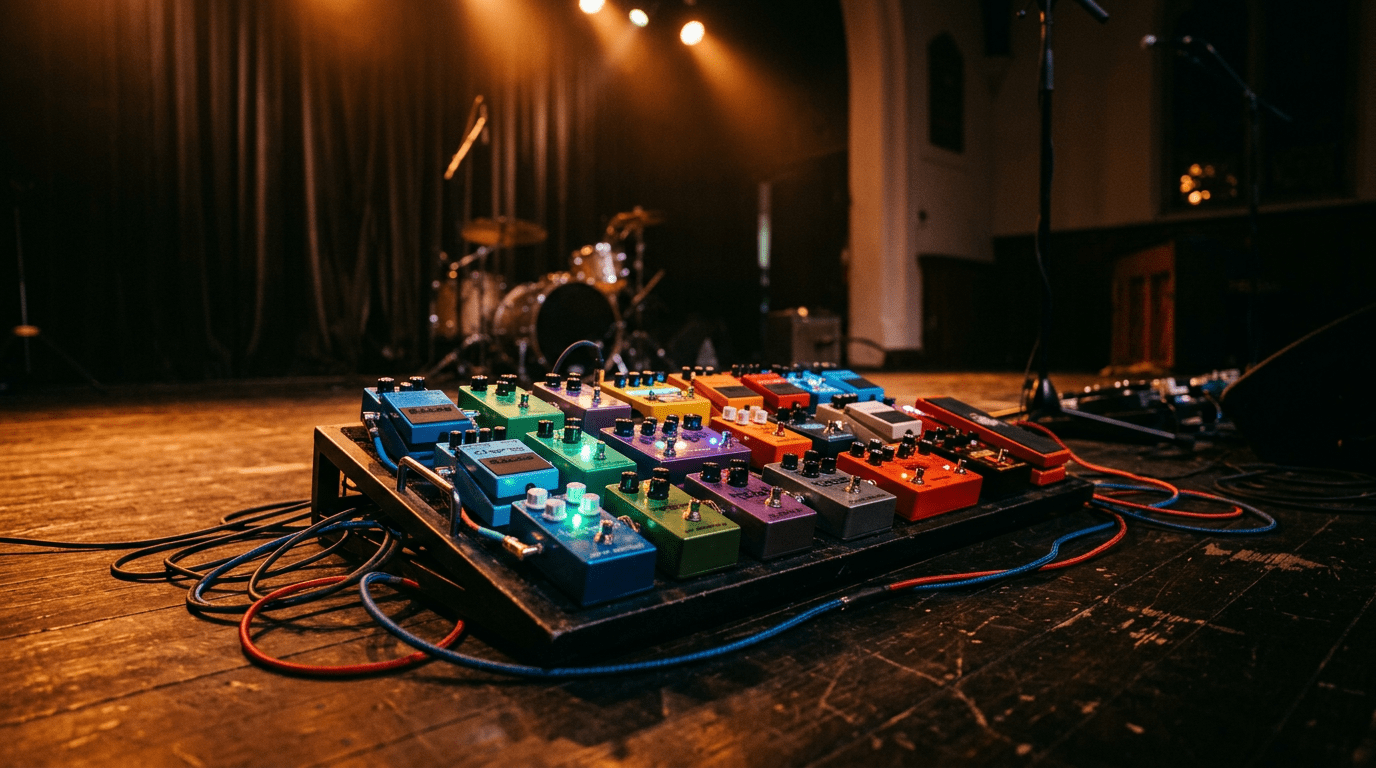
You have 12 pedals on your board. You spent real money on every one of them. And you still can’t get that sound.
The board is held together with zip ties and hope. Your cables are a tangled mess. You bought the same reverb your favorite Hillsong guitarist uses, plugged it in, and it sounded nothing like the recording. So you bought another pedal. Same result.
Here’s the thing most worship guitarists miss: a great worship guitar pedalboard isn’t about having more pedals. It’s about having the right ones, in the right order, dialed in for the room you’re actually playing in. This guide covers exactly how to build one that sounds good on Sunday — not just in your bedroom — whether your budget is $200 or $1,000.
Key Takeaways
- The five core pedal categories every worship guitar pedalboard needs, with specific models and prices
- Signal chain order matters more than which pedals you buy — get this wrong and nothing sounds right
- Three complete pedalboard builds at $200, $500, and $1,000 budget tiers
- The most common mistakes that make church guitarists sound muddy, harsh, or buried in the mix
Table of Contents
- The Core Pedals Every Worship Guitarist Needs
- Signal Chain Order
- Budget Pedalboard Builds ($200, $500, $1,000)
- The Tone Is in the Playing, Not Just the Pedals
- Power Supply and Board Setup Tips
- Common Worship Pedalboard Mistakes
- Frequently Asked Questions
- Build a Worship Guitar Pedalboard That Actually Serves the Song
The Core Pedals Every Worship Guitarist Needs
A worship guitar pedalboard doesn’t need 15 pedals. It needs the right five or six, chosen with intention. Here’s what belongs on every church guitarist’s board, listed in signal chain order.
Tuner
This is non-negotiable. If you’re tuning by ear between songs on a Sunday morning, the congregation notices. A good tuner pedal mutes your signal while you tune silently.
Best pick: The Boss TU-3 (~$100) is the industry standard. It’s been on more pedalboards than any other pedal in history. Accurate, bright display, built like a tank. If budget is tight, the TC Electronic PolyTune 3 Mini (~$80) saves space and tunes all strings at once.
Overdrive
This is where your worship tone lives. Overdrive adds grit, warmth, and presence without turning your amp into a wall of distortion. Most worship guitar tones use a low-to-medium gain overdrive — just enough to push your clean tone forward.
Budget pick: A Klon clone in the $30-60 range. Mosky Golden Horse, Tone City Bad Horse, or the Behringer Super Fuzz are surprisingly capable for the price. The Boss BD-2 Blues Driver (~$100) is another workhorse — transparent, responsive, stacks well.
Premium pick: The JHS Morning Glory (~$200) is a favorite among worship guitarists for good reason. It cleans up beautifully with your volume knob and sits perfectly in a full band mix. If you can only afford one quality pedal, make it your overdrive.
Modulation — Chorus
Chorus adds shimmer and width to your clean tones. Think of the lush, watery textures on Bethel and Elevation recordings. A subtle chorus on clean passages makes your guitar fill the room without competing with the vocals.
Budget pick: The Boss CE-2W (~$150) is a reissue of the most legendary chorus pedal ever made. Worth every penny. For tighter budgets, the TC Electronic Corona Chorus (~$80) covers similar ground.
Premium pick: The Walrus Audio Julia (~$200) offers analog chorus with a lag control that lets you dial in anything from subtle shimmer to deep warble. Beautiful on ambient parts.
Delay
Delay is the backbone of modern worship guitar tone. Dotted eighth notes. Ambient swells. Rhythmic repeats under a chorus. If you play worship guitar, you need delay. A worship guitar pedalboard without delay is like a drum kit without cymbals.
Budget pick: The Boss DD-8 (~$150) is compact, reliable, and covers everything from simple slapback to ambient shimmer. The TC Electronic Flashback 2 (~$130) is another strong option with TonePrint presets you can load from your phone.
Premium pick: The Strymon Timeline (~$400) is the gold standard for worship delay. Yes, it’s expensive. But if delay is the centerpiece of your sound, the Timeline earns its price with studio-quality algorithms and deep preset storage.
Reverb
Reverb creates space and depth. It makes your guitar sound like it belongs in the room — or in a cathedral. Worship guitar tones rely heavily on reverb to create atmosphere, especially during builds, intros, and prayer moments.< Check out our worship songs about prayer for more. /p>
Budget pick: The Boss RV-6 (~$130) packs hall, plate, shimmer, and modulated reverb into one pedal. Hard to beat at this price. The TC Electronic Hall of Fame 2 (~$120) is equally versatile with TonePrint customization.
Premium pick: The Strymon BigSky (~$400) is the reverb pedal you hear on most major worship recordings. Massive, lush, detailed. It’s the reason half the guitarists in your Instagram feed have Strymon on their board.
Signal Chain Order for Your Worship Guitar Pedalboard
You can buy the best pedals on the market and still sound terrible if your signal chain is wrong. Order matters. Here’s the standard signal chain that works for 90% of church guitar pedalboard setups:
Guitar → Tuner → Overdrive → Chorus → Delay → Reverb → Amp
Why this order? Each pedal processes what comes before it.
- Tuner first — gets a clean, unprocessed signal for the most accurate tuning
- Overdrive before modulation — you want to add grit to a clean signal, then shape that gritty tone with chorus, delay, and reverb
- Chorus before delay — chorusing the dry signal before it repeats sounds cleaner than chorusing the repeats themselves
- Delay before reverb — your delays ring out into the reverb, creating depth. Reverse this and your reverb trails get chopped by the delay repeats
There are exceptions. Some guitarists run reverb before delay for a specific ambient effect. But if you’re building your first worship guitar pedalboard, start with this order. It’s the foundation.
Budget Worship Pedalboard Builds
You don’t need $3,000 to sound good on Sunday. Here are three complete church guitar pedalboard builds at different price points.
The $200 Board — “Just Getting Started”
- Clip-on tuner (free if you already own one) or Donner DT-1 pedal tuner (~$30)
- Klon clone overdrive — Mosky Golden Horse (~$30)
- TC Electronic Flashback Mini delay (~$70)
- TC Electronic Hall of Fame Mini reverb (~$70)
Total: ~$200. No chorus yet, but delay and reverb cover your ambient needs. This board handles 80% of what Sunday requires. Add chorus later when the budget allows.
The $500 Board — “Solid and Versatile”
- Boss TU-3 tuner (~$100)
- Boss BD-2 Blues Driver overdrive (~$100)
- Boss CE-2W chorus (~$150)
- Boss DD-8 delay (~$150)
Total: ~$500. All Boss. Built to last. This is a worship guitar pedalboard that won’t let you down mid-set. You’re skipping a dedicated reverb pedal here because your amp’s built-in reverb or the DD-8’s shimmer mode can cover that ground. When you’re ready, add a dedicated reverb as pedal number five.
The $1,000 Board — “The Full Setup”
- Boss TU-3 tuner (~$100)
- JHS Morning Glory overdrive (~$200)
- Walrus Audio Julia chorus (~$200)
- Strymon Timeline delay (~$400)
- Boss RV-6 reverb (~$130)
Total: ~$1,030. This board competes with what you hear on records. Premium drive and delay where it matters most, solid chorus and reverb to complete the picture. This is the board that makes your worship leader smile during soundcheck.
The Tone Is in the Playing, Not Just the Pedals
Here’s the uncomfortable truth about worship pedals: two guitarists can use the exact same board and sound completely different.
The guitarist on the Elevation Worship recording isn’t just using a Strymon Timeline and a Klon. They’re playing a specific part. They know when to let a chord ring out and when to mute. They know the rhythm, the dynamics, the voicings. The delay is set to a specific tempo and subdivision. The volume swells happen at exact moments.
Buying the same gear gets you the same raw ingredients. But the recipe — the actual part — is what makes it sound like the recording.
That’s where knowing the exact guitar part matters more than any worship tone pedals on your board. Worship Online gives you album-accurate guitar tutorials for 800+ worship songs. Check out our worship guitar tutorials for more. You can solo the electric guitar part, mute everything else, and hear exactly what the guitarist plays — note for note, section by section.
The right pedals give you the palette. Knowing the part gives you the painting.< Check out our worship songs about healing for more. /em>
Power Supply and Board Setup Tips
Your worship guitar pedalboard is only as reliable as the power running through it. A bad power supply introduces hum, noise, and signal loss that no amount of tweaking will fix.
Invest in Isolated Power
Do not daisy-chain your pedals with a one-spot adapter. It works at home, but on a church stage with lighting rigs, PA systems, and other electronics sharing the same circuit, you will get noise. An isolated power supply gives each pedal its own clean power.
Budget: Donner DP-1 (~$40) — basic isolation, covers 8 pedals. Good enough for smaller boards.
Standard: Voodoo Lab Pedal Power 2 Plus (~$180) — the longtime industry standard. Fully isolated, clean power, fits under most boards.
Premium: Strymon Zuma (~$300) — dead quiet, compact, expandable. If you’re running power-hungry digital pedals like the Timeline or BigSky, this is the safest choice.
Choose the Right Board
A Pedaltrain Classic or Nano series (~$50-150 depending on size) gives you a solid aluminum frame with built-in cable management. Measure your pedals before buying. Leave room for one or two additions down the road.
Use Quality Patch Cables
Cheap cables are the number-one tone killer on a church guitar pedalboard. A bad solder joint or a corroded connector introduces crackling, signal loss, and intermittent cutouts — usually right in the middle of the second verse. EBS or Hosa pancake cables are reliable and affordable (~$5-8 each). Build your own with a solderless kit from Lava Cable or George L’s if you want custom lengths.
Common Worship Pedalboard Mistakes
These are the mistakes that keep worship pedals from sounding their best. Every one of them is fixable.
Too Much Gain on the Overdrive
Worship guitar tone is about presence, not distortion. If your overdrive sounds like a rock solo, it’s too much. Dial the gain back until the overdrive barely breaks up. You want warmth, not crunch. The drive should add texture to your clean tone, not replace it.
Delay and Reverb Fighting Each Other
Running heavy delay and heavy reverb at the same time turns your signal into mush. Choose which effect leads for each song section. Ambient intro? Lean on reverb, pull the delay back. Rhythmic chorus part? Let the dotted-eighth delay do the work and dial the reverb to a short plate. Not every pedal needs to be on for every section.
Never Adjusting Settings for the Room
The settings that sound great through headphones at home will sound completely different in your church sanctuary. A large room with hard walls and high ceilings already gives you natural reverb — so your pedalboard needs less from the reverb pedal. A carpeted room with low ceilings absorbs everything — you’ll want more reverb and delay to compensate. Arrive early. Adjust during soundcheck. Your bedroom is not your stage.
Buying Pedals Before Learning the Part
This is the most expensive mistake on the list. You hear a tone on a Bethel record and assume it’s a pedal you don’t own. So you buy one. But the real difference was the part itself — the chord voicing, the rhythmic pattern, the way the guitarist controlled their dynamics. New worship tone pedals won’t fix what’s actually a knowledge gap.
Skipping the Tuner
It seems minor until you’re mid-song and your B string is five cents flat. A tuner pedal lets you check silently between songs. Without one, you’re either tuning audibly (distracting) or hoping for the best (risky). On any worship pedalboard, the tuner is the least exciting pedal and the most important one.
Frequently Asked Questions
How many pedals do I need for a worship guitar pedalboard?
Start with four or five: tuner, overdrive, delay, reverb, and optionally chorus. That covers the vast majority of modern worship guitar sounds. You can always add a compressor, tremolo, or second drive later. But those first four are the foundation of any church guitar pedalboard.
What’s the best delay pedal for worship guitar?
At the budget level, the Boss DD-8 or TC Electronic Flashback 2. At the premium level, the Strymon Timeline. The most important thing is finding a delay that does dotted eighth notes well, since that subdivision appears in almost every modern worship guitar part.
Should I buy new or used worship pedals?
Used. Seriously. Pedals hold up well, and the used market (Reverb.com, Facebook Marketplace, local guitar shops) typically saves you 30-40%. A used Boss BD-2 for $60 sounds identical to a new one for $100. The $500 board in this guide could become a $350 board if you buy used.
Do I really need a Strymon to sound good at church?
No. Strymon pedals are excellent, but they are not the only path to great worship tone. A Boss DD-8 and RV-6 will get you 90% of the way there at a fraction of the cost. The difference between a $130 delay and a $400 delay is real, but it’s subtle — and most congregations will never hear it. Spend where it matters most to your playing. For most guitarists, that’s the overdrive.
How do I get the dotted-eighth delay sound?
Set your delay to dotted-eighth note mode (most modern delays have this as a subdivision option). Then set the tempo to match the song’s BPM. Many worship pedals have tap tempo — tap the quarter note pulse and select the dotted-eighth subdivision. The repeats should sit behind your playing, not on top of it. Mix the delay level at about 30-40% wet for a rhythmic texture that supports the song without overwhelming it.
Build a Worship Guitar Pedalboard That Actually Serves the Song
A great worship guitar pedalboard isn’t about the most expensive gear. It’s about having the right pedals, in the right order, set up for your room and your songs. Start with the basics: tuner, overdrive, delay, reverb. Get your signal chain right. Dial your settings during soundcheck, not at home.
And remember — the pedals are only half of it. The part you play through them is what the congregation actually hears. Know your part cold, and your board will do the rest.
Start your free trial of Worship Online. Your whole team gets album-accurate tutorials for electric guitar, acoustic guitar, bass, drums, keys, and vocals for 800+ worship songs. Every musician learns their exact part before rehearsal. Rehearsals become about refining, not reteaching. Start your free, no-risk 14-day trial.