
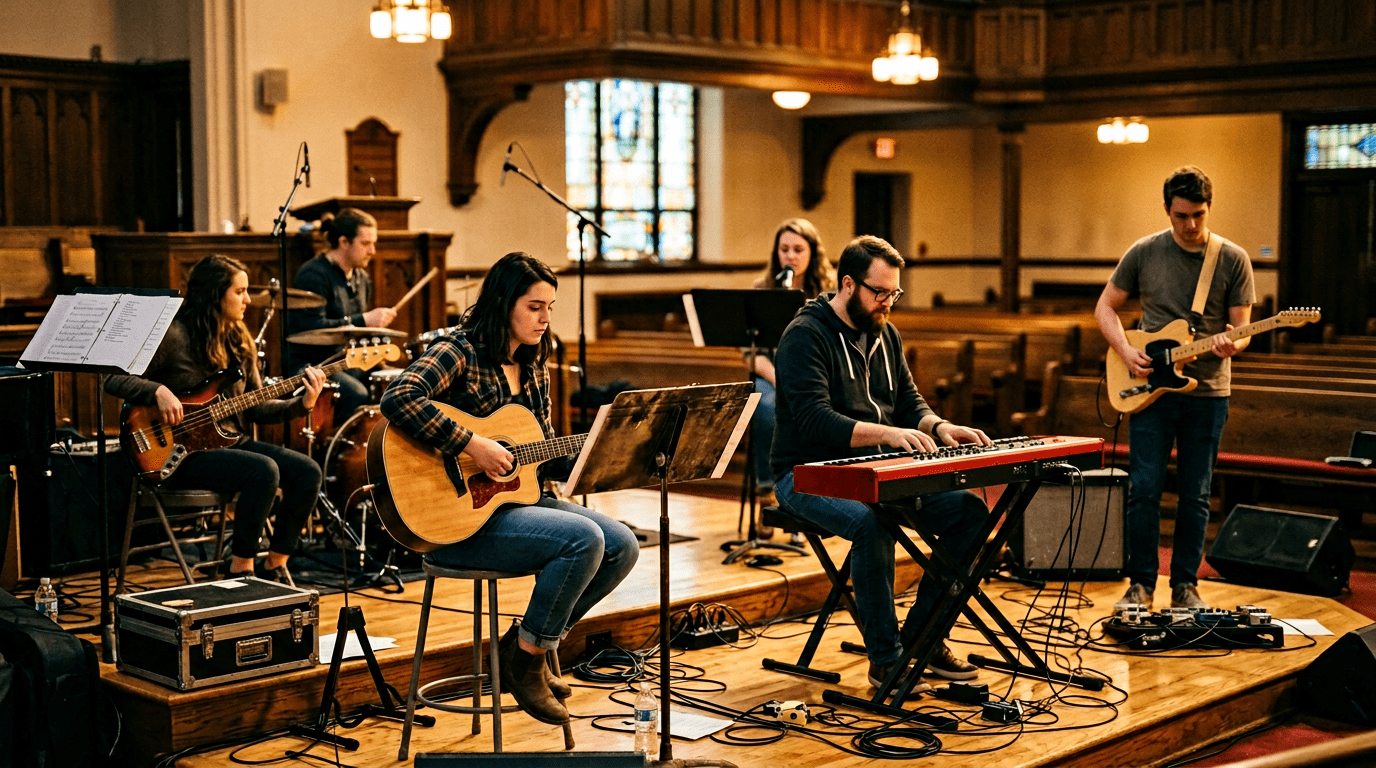
If you lead a worship team, you’ve lived this: rehearsal starts late. Half your musicians are guessing their parts. You spend 45 minutes reteaching the same song. Everyone leaves frustrated. And Sunday is three days away.
It doesn’t have to work that way. The best worship rehearsal tips aren’t about adding more time. They’re about using the time you already have.
These 15 worship rehearsal tips will help you run tighter rehearsals, prepare your team faster, and walk into Sunday with confidence. Most of them take zero extra budget and less than five minutes to implement.
Key Takeaways
- 15 practical worship rehearsal tips you can implement this week
- How to shift rehearsals from reteaching parts to refining the feel
- Specific strategies for setlist prep, communication, and team culture
- Tips work for any team size, any church, any budget
Table of Contents
- 1. Send the Setlist by Wednesday
- 2. Assign Parts, Not Just Songs
- 3. Start on Time, Every Time
- 4. Rehearse the Hardest Song First
- 5. Run Transitions, Not Just Songs
- 6. Stop Reteaching and Start Refining
- 7. Use a Click Track
- 8. Set Time Limits Per Song
- 9. Record Your Rehearsals
- 10. Communicate Keys and Tempos Before Rehearsal
- 11. Less Talking, More Playing
- 12. End with the Set, Not a Song
- 13. Do a Two-Minute Debrief
- 14. Introduce One New Song at a Time
- 15. Give Your Team the Right Resources
- Frequently Asked Questions
- Make Every Rehearsal Count
1. Send the Setlist by Wednesday
This is the single most impactful worship rehearsal tip on this list. Send the setlist at least three days before rehearsal. Include the song titles, keys, tempos, and links to reference recordings or tutorials.
When musicians get the setlist Thursday night or Friday morning, they don’t have time to prepare. They show up guessing. And your rehearsal becomes a teaching session instead of a practice session.
Wednesday gives your team two full days to listen, learn their parts, and walk in ready.
2. Assign Parts, Not Just Songs
Sending a song title isn’t enough. Your electric guitarist doesn’t need to hear the whole band. They need to hear exactly what the electric guitar plays.
Here’s what happens in most worship teams: you send the setlist, everyone listens to the full song on Spotify, and they show up hoping they’ll figure out their part during rehearsal. That’s not preparation. That’s guessing.
Break it down by instrument. If you have two electric guitarists, one gets the lead line, the other gets rhythm. Your bassist gets the bass part. Your keys player gets the keys part. When each musician knows their specific part before they walk in the door, rehearsal stops being a classroom. Worship Online is built for exactly this. You assign each musician their instrument, and they learn the exact part from the original recording. No guessing. No overlap. Just clarity.
3. Start on Time, Every Time
If rehearsal starts at 7:00, play the first note at 7:00. Not 7:15 after everyone has caught up on their week. Late starts steal time from the songs that need the most work.
Set the expectation once. Then follow through. Your team will adjust. The ones who show up on time will thank you. And the ones who don’t will learn that rehearsal doesn’t wait.
4. Rehearse the Hardest Song First
Energy and focus peak at the start of rehearsal. Use that window for the song that needs the most attention. The new song. The one with tricky transitions. The arrangement your team hasn’t nailed yet.
If you save the hard song for last, your team is tired and distracted. You’ll run out of time or push through it sloppily. Neither helps Sunday.
This is one of those worship rehearsal tips that feels obvious but almost nobody does. Put the hardest song first. Watch the difference.
5. Run Transitions, Not Just Songs
Most worship teams rehearse each song in isolation. They never practice how the set flows together. Then Sunday comes and the transitions are clunky. Dead air between songs. Key changes that feel jarring. Awkward starts.
Run the last chorus of one song into the intro of the next. Practice the moment between songs as deliberately as you practice the songs themselves. That’s where a set becomes a journey.
6. Stop Reteaching and Start Refining
If your rehearsals consist of teaching parts from scratch, you don’t have a rehearsal problem. You have a preparation problem.
Think about it. You’re spending rehearsal time fixing parts that should’ve been learned at home. That’s not refining dynamics. That’s not working on feel. That’s reteaching. And it’s burning through time you don’t have.
The shift is simple: your team needs to know their parts before they walk in the door. When they do, rehearsal becomes about locking in together. Tightening transitions. Building the feel. That’s the rehearsal every worship leader wants. Worship Online exists because of this exact problem. Every musician gets the exact part from the original recording. They solo their instrument. They loop the hard section. They slow it down until they’ve got it. Then they walk into rehearsal ready. Not guessing. Ready.
This is the worship rehearsal tip that changes everything else on this list.
7. Use a Click Track
A click track keeps your band locked in. It prevents tempo drift. It makes transitions cleaner. And it keeps your drummer honest.
If your team has never used a click, start simple. Run it through in-ear monitors or a floor monitor facing the drummer. Let the team get used to it during rehearsal before introducing it on Sunday. Most worship leaders who start using a click never go back.
8. Set Time Limits Per Song
Without time limits, one problem song eats your entire rehearsal. Set a cap. Ten minutes per song for a five-song set gives you 50 minutes of music time plus 10-15 minutes for transitions and run-throughs.
If a song isn’t coming together in 10 minutes, the issue probably isn’t rehearsal. It’s preparation. Flag it. Move on. Address the root cause before next week. These worship rehearsal tips only work when the underlying preparation is in place.
9. Record Your Rehearsals
Set up a phone or a simple recorder in the room. Record the full rehearsal. You’ll hear things in playback that you missed in the moment. Balance issues. Timing problems. Parts that clash.
Share the recording with your team. Let them hear what the congregation hears. This is one of the most effective worship rehearsal tips for teams that think they sound good but can’t figure out why Sunday still feels off.
10. Communicate Keys and Tempos Before Rehearsal
Nothing wastes more rehearsal time than discovering at 7:05 that the song is in a different key than what your guitarist prepared. Or that the tempo is faster than the recording they practiced with.
Include exact keys and BPM in every setlist you send. If you’re transposing a song to fit your vocalist’s range, communicate that early. Your team needs to practice in the correct key from the start, not discover it at rehearsal.
11. Less Talking, More Playing
A common rehearsal killer: the worship leader talks for five minutes between every song. Explaining the feel. Sharing the vision. Telling a story about what the song means.
Save that for Sunday. Rehearsal is for playing. Keep verbal direction to 30 seconds or less between songs. Be specific: “Let’s pull back the dynamics on verse two” hits harder than a three-minute monologue about atmosphere. This worship rehearsal tip alone can save 15-20 minutes per session.
12. End with the Set, Not a Song
Your last run-through should be the full set, top to bottom, with transitions. No stopping. Treat it like Sunday morning. This builds confidence and reveals any remaining issues in real time.
If you only rehearse songs individually, your team never practices the experience your congregation will actually have. The full run-through is where it all comes together.
13. Do a Two-Minute Debrief
Before everyone packs up, take two minutes. What worked? What needs attention? Is there a specific moment that felt off?
Keep it constructive and brief. Don’t open it for a 20-minute discussion. The goal is to capture the one or two things your team should focus on during personal practice before Sunday. Write them down and send them to the group.
14. Introduce One New Song at a Time
Adding three new songs to a setlist is a recipe for a stressful rehearsal. Your team can’t learn that much in one week, especially volunteers who practice a few hours at most.
Introduce one new song per setlist. Keep the rest familiar. This gives your team confidence in what they know while stretching just enough to grow. Rotate the new song into the “familiar” category over two to three weeks. These worship rehearsal tips compound over time. In two months, you’ll have eight new songs in rotation without ever overwhelming your team.
15. Give Your Team the Right Resources
You can’t tell your team to “come prepared” and then give them nothing to prepare with.
YouTube videos with ads. Inaccurate chord charts from the internet. “Just listen to the song.” That’s not a system. That’s hoping for the best. And hope is not preparation.
Your guitarist needs the exact guitar part. Your vocalist needs to hear the harmony isolated from everything else. Your drummer needs the kick and snare pattern without the rest of the band drowning it out. That’s what prepared actually looks like.
Worship Online was built for this moment. 800+ worship songs. Every instrument taught by musicians from Elevation Worship, Bethel, Brandon Lake, and Lauren Daigle. Your team solos their part, loops the hard section, slows it down, and learns it in the right key. When your musicians walk into rehearsal knowing “I’ve got this,” everything changes. Rehearsal becomes refining, not reteaching. And Sunday stops being something you survive.
Frequently Asked Questions
How long should a worship rehearsal be?
60 to 90 minutes is the sweet spot for most teams. Shorter than 60 and you can’t run the full set with transitions. Longer than 90 and you lose focus, especially with volunteer musicians who have families and jobs.
How often should a worship team rehearse?
Once a week is standard for most churches. Some larger teams rehearse twice: once midweek for music, once on Sunday morning for a sound check and run-through. If your team can only meet once, make that rehearsal count with the worship rehearsal tips above.
What do you do when a team member consistently comes unprepared?
Have a private conversation. Ask what’s getting in the way. Often it’s not a commitment problem. It’s a resource problem. They don’t know where to find accurate parts. They’re spending hours on YouTube guessing. Give them the right tools and set clear expectations about preparation.
How many songs should be in a worship set?
Most churches do four to six songs per service. That gives you 20 to 30 minutes of music. Plan your rehearsal around this number. If you have five songs, allocate about 10 minutes per song plus 15 minutes for transitions and a full run-through.
Should worship rehearsals include prayer or devotional time?
A brief opening prayer sets the tone. But extended devotionals can eat into music time. Keep spiritual preparation to five minutes or less during rehearsal. If you want deeper team devotionals, schedule them separately so rehearsal stays focused on music.
Make Every Worship Rehearsal Count
Good worship rehearsal tips don’t add more to your plate. They take what’s already there and make it work. Send the setlist early. Assign specific parts. Start on time. Rehearse the hard stuff first. Run your transitions. And stop reteaching what your team should already know.
It’s not a talent problem. It’s not a time problem. It’s a system problem. And when the system is right, everything else falls into place.
Start your free trial of Worship Online. Your whole team learns their exact part before rehearsal. No more guessing. No more reteaching. Just confident musicians who show up ready. Start your free, no-risk 14-day trial.