
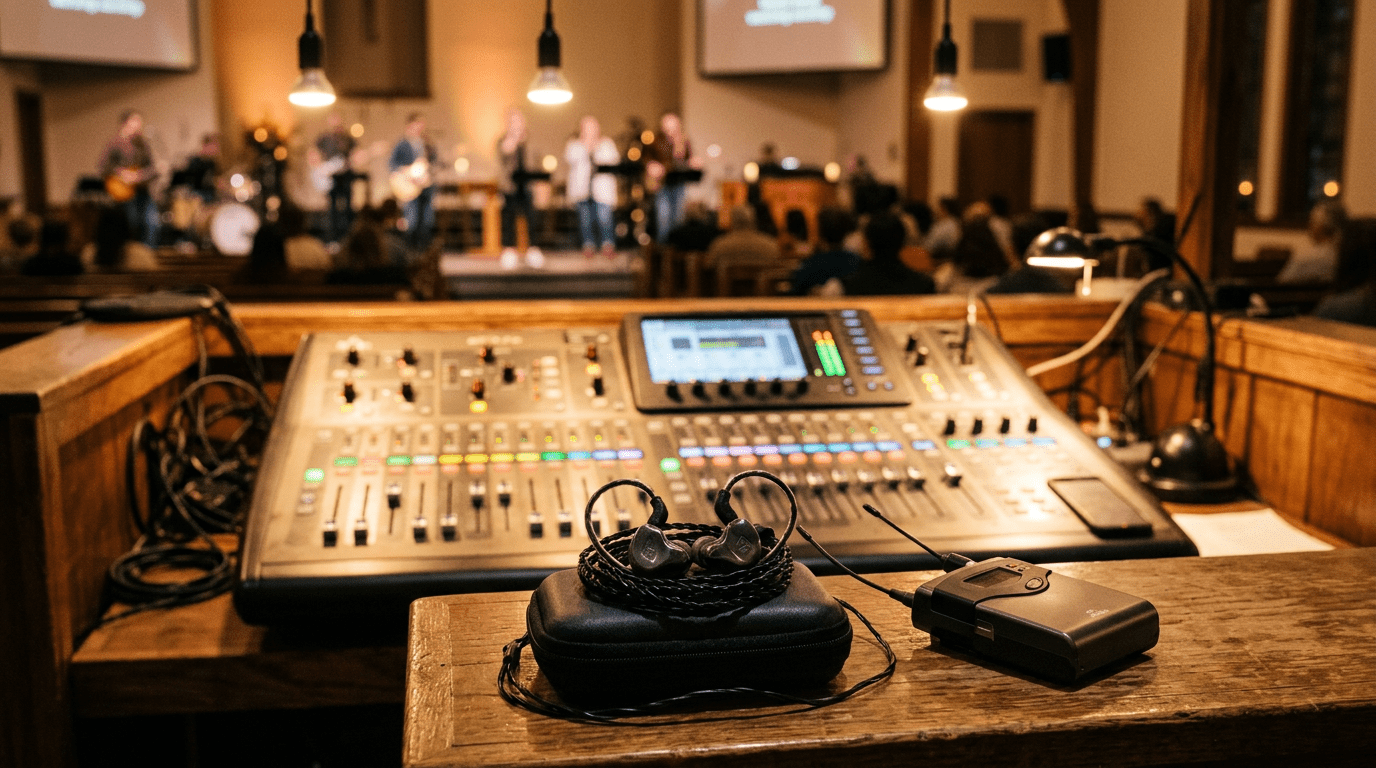
Your drummer can’t hear the click. Your vocalist is pushing harder because she can’t hear herself in the floor wedge. Your keys player is guessing at dynamics because the stage volume is a wall of noise. And you — the worship leader — have been asking the church for in-ear monitors for two years.
You’re not asking for something fancy. You’re asking for something that works. The best in-ear monitors for worship don’t have to cost thousands. They just have to solve the right problems: clarity, isolation, and reliability on a real church budget.
This guide breaks down the best in-ear monitors for worship teams at every price point. Budget. Mid-range. Premium. With specific models, approximate prices, and honest assessments of what actually holds up on a Sunday morning stage.
Key Takeaways
- The best in-ear monitors for worship start under $50 — you don’t need to spend hundreds to hear clearly on stage
- Fit and isolation matter more than driver count for most worship team members
- Wireless IEM systems are ideal but wired setups work great on tight budgets
- Good monitors only help if your team knows their parts — clarity reveals preparation (or the lack of it)
Table of Contents
- Why In-Ear Monitors Matter for Worship Teams
- What to Look For in Worship IEMs
- Best Budget IEMs for Worship (Under $50)
- Best Mid-Range IEMs for Worship ($50-$150)
- Best Premium IEMs for Worship ($150+)
- How to Set Up IEMs for Your Worship Team
- Common IEM Mistakes to Avoid
- Frequently Asked Questions
- Find the Best In-Ear Monitors for Your Worship Team
Why In-Ear Monitors Matter for Worship Teams
Floor monitors create a problem most worship teams don’t even realize they have. The louder the stage gets, the harder everyone plays. The harder everyone plays, the muddier the mix becomes. And no one hears what they actually need to hear.
In-ear monitors solve this by giving each musician their own personal mix. The drummer hears the click and the bass. The vocalist hears themselves and the piano. The electric guitarist hears the acoustic for timing without the full band drowning out their part. Everyone gets exactly what they need.
The difference is immediate. Stage volume drops. The front-of-house engineer stops fighting the wedges. Vocalists stop pushing their voices. Musicians play with more control. The best in-ear monitors for worship don’t just improve sound. They improve how your team plays together.
And there’s something else. When your team can actually hear themselves clearly, mistakes become obvious. That’s a good thing. It forces preparation. It raises the standard. It’s harder to coast when you can hear every note you play.
What to Look For in Worship IEMs
Not all IEMs are built the same. Before you buy anything, understand what actually matters for a worship context.
Drivers. Single-driver IEMs handle most worship applications well. Dual-driver and hybrid models (one balanced armature + one dynamic driver) give you better separation between lows and highs. More drivers usually mean more clarity — but also more cost. For most church musicians, a single or dual-driver setup is plenty.
Fit. This is the one most people underestimate. If your IEMs don’t stay in your ears during a 45-minute set, nothing else matters. Over-ear cable routing (where the cable hooks behind your ear) is standard for stage use. Foam tips generally seal better than silicone and stay put longer. Every ear is different. Budget for a few sets of replacement tips.
Isolation. Good isolation means outside noise stays out. That’s the whole point. You want at least 20-25 dB of noise reduction. Without it, you’ll crank your IEM volume to compete with stage bleed — and that defeats the purpose. The best in-ear monitors for worship seal well enough that you hear your mix, not the room.
Durability. Church gear takes a beating. Cables get yanked. IEMs get tossed in bags. Detachable cables are essential — when a cable fails (and it will), you replace the cable, not the whole unit. Look for reinforced connectors and thick, braided cables.
Best Budget IEMs for Worship (Under $50)
You don’t need to wait until the church approves a big budget. These are the most affordable IEMs for worship that still deliver on stage. They cost less than most teams spend on strings in a month.
KZ ZSN Pro X (~$20)
This is the IEM that changed what budget means. The KZ ZSN Pro X uses a hybrid driver setup — one balanced armature and one dynamic driver — at a price that seems wrong. The low end is warm without being boomy. The highs are crisp enough to hear click tracks and vocal cues clearly.
The fit is solid with the included ear tips, though upgrading to foam tips improves isolation. The detachable cable uses a standard 2-pin connector. If a cable goes bad, you swap it for a few dollars. For church in-ear monitors on a strict budget, this is where you start. Buy a pair for every musician on your team and you’ve spent less than a single premium IEM.
MEE Audio M6 PRO (~$50)
The M6 PRO has been a staple for worship teams and gigging musicians for years. It’s built for stage use. The over-ear design locks in. The noise isolation is excellent for the price — around 22 dB. The detachable cable is sturdy. The included case is road-tested.
Sound-wise, it’s balanced and honest. Not hyped. Not flashy. You hear what’s in your mix without coloration. That’s exactly what you want on a worship stage. If a team member needs reliable church in-ear monitors and you have fifty dollars, this is the safe bet.
Shure SE215 (~$99, Often on Sale for $50-$70)
Technically above the $50 line at retail, but the SE215 goes on sale so often that most worship teams pick them up in the $50-$70 range. It’s the most recommended entry-level IEM in worship circles for a reason. The isolation is outstanding. Up to 37 dB of noise reduction. The low end is full without overwhelming the mids. The fit is comfortable for long services.
The SE215 uses Shure’s MMCX detachable cable system. Replacement cables are everywhere. If you’re building your first set of in-ear monitors for your worship team and can catch these on sale, they’re hard to beat at any price under $100.
Best Mid-Range IEMs for Worship ($50-$150)
This is where most worship teams land when they’re serious about IEMs but not ready for custom molds. The best in-ear monitors for worship in this range give you noticeably better sound, comfort, and build quality.
Shure SE215 (Full Price, ~$99)
At full retail, the SE215 still earns its spot. Single dynamic driver with a warm, full sound. The sound isolation alone justifies the price for worship applications. This is the workhorse. It’s the IEM you’ll see on more church stages than any other. Your sound tech probably owns a pair.
Durability is proven. Comfort holds through long rehearsals and double services. There’s a reason this model has been the default recommendation for worship IEMs for over a decade.
Westone UM Pro 10 (~$100)
Westone builds IEMs specifically for professional stage use. The UM Pro 10 uses a single balanced armature driver tuned for accuracy. Where the SE215 leans warm, the UM Pro 10 leans neutral. You hear your mix exactly as it is. No flattery. No hype.
The real advantage is comfort. Westone’s shell design is smaller and lighter than most competitors. For vocalists and musicians who wear IEMs through a full rehearsal plus two Sunday services, comfort matters as much as sound. The UM Pro 10 disappears in your ears. That’s the point.
Linsoul TIN T2 (~$50)
The TIN T2 is the audiophile pick at a worship budget price. Dual dynamic drivers with a sound signature that punches well above its cost. The mids are detailed — vocals and acoustic guitar sit forward in the mix. The highs are clean without being harsh.
Build quality is solid metal, not plastic. The cable is detachable. For musicians who care about sound accuracy and want to hear every detail in their monitor mix, the TIN T2 delivers. It’s less proven in church circles than the Shure or Westone options, but the sound-per-dollar ratio is excellent.
Best Premium IEMs for Worship ($150+)
If your church is ready to invest in long-term gear, these are the best in-ear monitors for worship teams that want professional-grade clarity and durability.
Shure SE425 (~$250)
Dual balanced armature drivers. This is where you start hearing what professional musicians hear. The SE425 separates instruments in your mix with a precision that single-driver IEMs can’t match. Vocals sit in one space. Guitar sits in another. Kick drum is distinct from bass. Everything has its own room.
For worship leaders who need to hear lyrics, monitor the band, and follow cues simultaneously, the SE425’s clarity is a meaningful upgrade. The isolation is Shure-level excellent. The build quality is designed for years of weekly use. If you’re buying one premium pair for the worship leader or music director, this is the one.
Westone UM Pro 20 (~$200)
Dual balanced armature drivers from Westone’s professional stage line. The UM Pro 20 adds a low-frequency driver to the UM Pro 10’s foundation. The result is a fuller, more balanced sound with real low-end presence — something drummers and bassists will appreciate.
Westone’s comfort advantage carries over. These are IEMs you forget you’re wearing. For teams running two services plus a rehearsal in the same week, that comfort adds up. The UM Pro 20 is a professional-grade church in-ear monitor that will last for years.
Custom Molded IEMs (64 Audio, Ultimate Ears, JH Audio — $500+)
Custom-molded IEMs are the aspirational endpoint. An audiologist takes impressions of your ears. The manufacturer builds shells that fit your ear canals exactly. The seal is perfect. The comfort is unmatched. The sound is the best you’ll ever hear on stage.
Brands like 64 Audio, Ultimate Ears, and JH Audio lead the custom IEM space. Prices start around $500 and climb past $2,000 depending on driver configuration. For most church budgets, this is a long-term goal, not a Tuesday purchase. But if your church has the resources, custom molds for your worship leader and key musicians are a worthwhile investment that lasts for years.
Prices may vary. Check current pricing at your preferred retailer.
How to Set Up IEMs for Your Worship Team
Buying the best in-ear monitors for worship is step one. Setting them up correctly is what actually makes the difference on Sunday.
Wired vs. Wireless
Wired IEM setups are simple and cheap. Run a cable from the monitor send on your mixer to a headphone amplifier on stage. Each musician plugs in and gets their mix. Total cost: the IEMs plus a multi-channel headphone amp ($50-$200). This works perfectly for teams on a budget.
Wireless IEM systems (like the Shure PSM300 or Galaxy Audio AS-1800) give musicians freedom to move. The transmitter connects to your mixer’s aux send. Each musician wears a bodypack receiver. Expect $300-$600 per channel. More expensive, but for vocalists and worship leaders who move across the stage, wireless is worth it.
Start wired. Upgrade to wireless as budget allows. Most churches run a hybrid — wireless for the worship leader and vocalists, wired for the band.
Mixing Tips
The number one complaint from musicians new to IEMs: “I can’t hear myself.” That’s a mix problem, not an IEM problem.
Start with the musician’s own instrument panned center and louder than everything else. Add the click track. Then layer in other instruments one at a time. Less is more. A worship IEM mix should have three to five elements, not the full band. The vocalist needs their voice, the keys for pitch reference, and the click. The guitarist needs their guitar, the click, and maybe the bass for groove. Every musician gets a different mix. That’s the whole point.
Good IEMs only matter if your team knows their parts. The monitors help you hear — but you need to know what to play. Worship Online gives every musician on your team album-accurate tutorials for their exact instrument. Electric guitar, acoustic guitar, bass, drums, keys, and vocals — 800+ worship songs. When your team knows their parts cold, IEMs don’t just improve sound. They amplify preparation.
Common IEM Mistakes to Avoid
Most worship teams make the same mistakes when switching to in-ear monitors. Avoid these and you’ll save time, money, and frustration.
Running IEMs too loud. One of the main benefits of IEMs is protecting your hearing. If you’re cranking the volume to compensate for a bad mix or poor seal, you’re doing more damage than floor wedges ever did. Fix the mix. Fix the fit. Keep the volume reasonable.
Using one generic mix for everyone. This defeats the purpose of the best in-ear monitors for worship. Each musician needs their own aux send with their own mix. If your mixer doesn’t have enough aux sends, prioritize the vocalist and worship leader first.
Skipping foam tips. The silicone tips that ship with most IEMs look fine. They don’t seal well. Foam tips (like Comply or generic memory foam) compress into your ear canal and expand for a tighter fit. Better seal means better isolation, better bass response, and lower volume levels. A $10 upgrade that changes everything.
Not giving the team time to adjust. Musicians who’ve used floor wedges for years will feel disconnected the first time they switch to IEMs. The room disappears. They can’t hear the congregation. It feels isolating. That’s normal. Give your team two to three rehearsals to adjust before using IEMs on Sunday. Some teams add an ambient mic to the IEM mix so musicians can hear a little bit of the room. It helps with the transition.
Buying cheap wireless systems. Budget wireless IEM systems ($100-$200 range) often have signal dropouts, limited frequency response, and interference issues. If you can’t afford a reliable wireless system, stay wired. A good wired setup beats a bad wireless one every time.
Frequently Asked Questions
What are the best in-ear monitors for worship on a tight budget?
The KZ ZSN Pro X (~$20) is the best value for church in-ear monitors. Hybrid drivers, detachable cable, and surprisingly good sound for the price. If you can stretch to $50, the MEE Audio M6 PRO adds better isolation and build quality. Both are proven on worship stages.
Do I need wireless IEMs for my worship team?
Not necessarily. Wired IEM setups work well for stationary musicians like drummers, bassists, and keys players. Wireless is most valuable for vocalists and worship leaders who move across the stage. Start wired and upgrade selectively.
How many aux sends do I need for in-ear monitors?
One aux send per unique IEM mix. Ideally, every musician gets their own. At minimum, you need separate mixes for the worship leader, the vocalist(s), and the band. A 16-channel mixer with six aux sends covers most worship teams. If your mixer is limited, a personal monitor mixer like the Behringer Powerplay P16 lets each musician dial in their own mix.
Can I use regular earbuds as in-ear monitors?
You can, but you shouldn’t. Consumer earbuds like AirPods have almost no noise isolation. You’ll crank the volume to hear over the stage, which damages your hearing. They also fall out easily and have unpredictable frequency response. Even a $20 pair of proper IEMs with foam tips will outperform $200 consumer earbuds in a worship context.
How do I convince my church to invest in IEMs?
Frame it around three things the church leadership cares about: hearing protection (liability), lower stage volume (better experience for the congregation), and improved sound quality (tighter mix, fewer feedback issues). Start small. Buy two or three budget pairs for the musicians who need them most. Let the results make the case for expanding.
Find the Best In-Ear Monitors for Your Worship Team
The best in-ear monitors for worship aren’t the most expensive ones. They’re the ones that fit your team, fit your budget, and actually get used every Sunday. A $20 KZ ZSN Pro X in every musician’s ears beats a $250 Shure sitting in someone’s drawer because the church could only afford one pair.
Start where you are. Budget IEMs with foam tips and a decent mix will transform your stage sound overnight. Upgrade as your church grows. The gear matters — but not as much as preparation. The clearest monitor mix in the world won’t help a musician who doesn’t know their part.
Clarity starts before Sunday. It starts in practice. It starts with knowing the exact part, in the right key, at the right tempo. The best in-ear monitors for worship reveal what’s there. Make sure what’s there is worth hearing.
Start your free trial of Worship Online. Your whole team gets album-accurate tutorials for electric guitar, acoustic guitar, bass, drums, keys, and vocals for 800+ worship songs. Every musician learns their exact part before rehearsal. Rehearsals become about refining, not reteaching. Start your free, no-risk 14-day trial.