
Being a musician is an expensive trade. For the price of many guitarist’s rigs you can buy a pretty decent car.
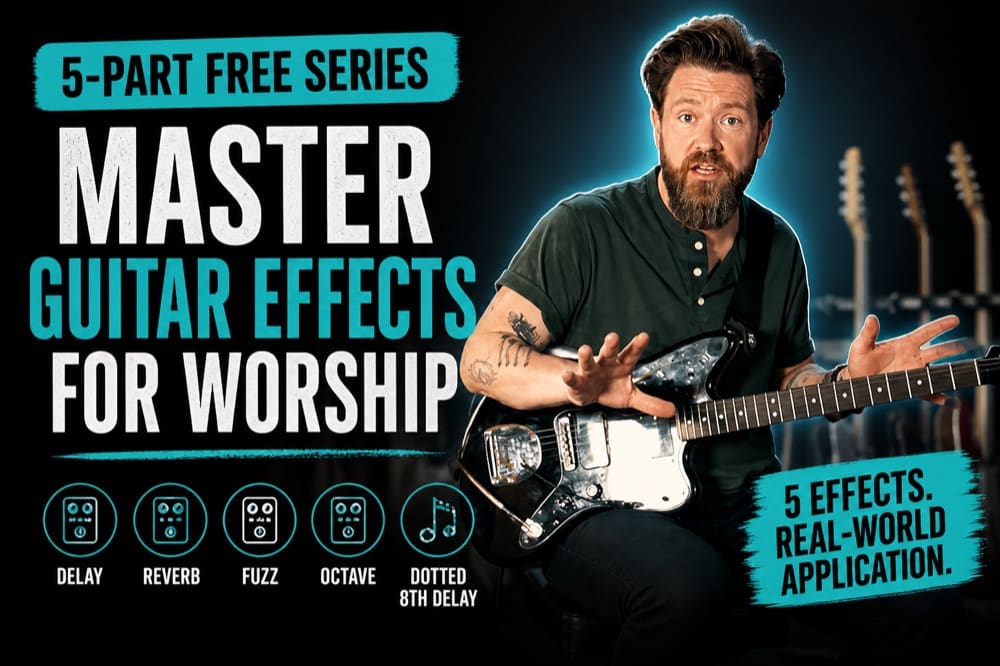
Want better tones from the pedals you already own? Watch the free 5-part worship guitar effects series.
However, most of us did not start off with custom guitars and 30” pedalboards with boutique pedals running into Matchless’s and Divided by 13’s. We have all had smaller rigs and worked our way up to larger setups that help us express what we have learned to play.
Over the past 15+ years of serving in the church, I have learned a lot about budgeting and started pretty small myself. In this blog I’m going to offer some advice to help show you that you do not need much to sound great on Sunday.
How I Started.
I don’t talk about this much because it’s a tad embarrassing, but it really does show we all start somewhere. When I started playing guitar, I was more concerned with how many notes I could play in one measure than taste.
My first worship rig was along the lines of a Gibson SG with EMG’s, a OD808, Vintage Rat (still use this), Korg Pitch Black tuner, SKB pedalboard, a vintage Ibanez DL-10 I borrowed from my friend’s dad (pretty cool actually), and some onboard effects with my Behringer modeling amp head (ran direct to FOH). I later “upgraded” to a vintage Randall 100w tube combo amp that weighed 100lbs that I found at Guitar Center.
Don’t feel like you have to buy expensive gear to serve well in church.
I have played with musicians that had the most expensive gear you could find at the time and their tone was rather immature. There is definitely truth to the fact that certain gear can make you sound better. However, nice gear cannot guarantee that you sound experienced.
Average gear can sound great.
Don’t get caught up in the boutique brand names you see popping up on Instagram. Some of my favorite pedals are made by Boss. I dropped playing my boutique amps I had for years to play a pair of “average” Fender Deluxe Reverbs because I liked the way they sounded more.
Learn the gear market.
I have learned to look for deals. Pretty much everything I have bought is used or through a deal I have. I have bought tons of gear on The Gear Page, eBay, Craigslist, and Reverb.
Reverb is a little bit more expensive since it’s a very popular website where they charge fees and sellers in turn have higher price points. (For US sellers, Reverb lists a 5% selling fee plus payment processing, 8.19% + $0.49 in total.) Forums and Craigslist are usually where I have found the best deals.
As you upgrade, learn how to sell gear. Over the years, I have bought and sold countless items. I’ve never really been in a financial spot to collect a lot of gear, so if I wanted to upgrade, I sold gear to make room. Take great photos and make your gear look like the best item on the site.

If I had $2000 to spend on a rig.
The easiest solution from what I’ve found is to invest in a guitar that plays decently, swap out the pickups, and buy a great modeling system. When I first wrote this, I played a Fractal AX8 and loved it. Fractal has since replaced the AX8 with the FM3, and the current FM3 Mark II Turbo lists at $1,099.99 on Fractal’s store at the time of writing. That still leaves room for a good used guitar under $2000, and you get tons of great sounding effects to experiment with. You can run it straight to the sound board, like I did with my first modeling amp.
If you would rather have an amp and pedals, here is how the two paths compare at new prices from the maker or Sweetwater at the time of writing:
| Modeler rig | Amp and pedals | |
|---|---|---|
| Amp sound | Fractal FM3 Mk II Turbo, $1,099.99 | Vox AC15C1, $799.99 |
| Effects | Built in | Tuner, overdrive, delay and reverb, about $577 (list below) |
| Left for a guitar | About $900 | About $620 |
Either way, buy the guitar used and you will get a lot more for the money.
Other cool options could be:
Amps
I have a vintage JC-60 I got for $350 that I love. A new Roland JC-120 is $1,399.99 at Sweetwater at the time of writing and lets you run stereo, so look for a used one. Fender Deluxe Reverbs will sound fantastic. A new ’65 Deluxe Reverb is $1,784.99 at Sweetwater, so on this budget, buy used. I don’t know if this is as much a thing anymore, but people used to buy Peavey Classic 30’s and swap the speakers a lot (Peavey still lists the Classic 30 at $999.99). A lot of people play AC-15’s, and they work, but I find them to be a bit brittle sometimes. That can also easily be adjusted with a speaker swap though.
Note: It’s nice to eventually get to a stereo rig if your church has the space available, but by no means is it necessary. I have run mono live many times.
Guitars
I think Duo-Sonics are super cool. If I wasn’t 6’4” I would probably play one (they have a shorter scale length). Fender’s old Duo-Sonic product page is gone, so look for a used one.
American Strats are worth hunting for used. A new American Professional Stratocaster is $1,799.99 on Fender’s site at the time of writing, which eats almost the whole budget. I bought a really great Japanese Tele for around $750 back in the day because I found a deal on a forum.
Pickups are a great upgrade for a budget guitar and make the world of difference in tone (if the originals are not great). Everyone says put Lollar’s in your guitar, but you don’t have to spend that much. I have put Lace Sensors in my Strat, which are incredibly affordable: a Lace Sensor Gold is $92 on Lace’s own site at the time of writing. Do your research and see if you want a certain brand before buying. Don’t just give into hype.
Effects
A tuner, couple of overdrives, a delay with tap tempo, and maybe a reverb is all you really need.
Here is what that costs new at the time of writing:
- Tuner: Boss TU-3, $89.96 at Sweetwater
- Overdrive: MXR Timmy, $159.99 on Dunlop’s site
- Delay with tap tempo: Boss DD-8, $197.99 at Sweetwater
- Reverb: TC Electronic Hall of Fame 2, $129 at Sweetwater
That is about $577 for a very solid board before a second overdrive. The OD808 I started with is no longer sold new (Sweetwater lists it as no longer available), so look for a used one if you want that sound. Buying any of these used saves even more.
Practice
Of course I have to end this all with a reminder to put time into learning your instrument. If you practice enough you can absolutely sound professional with $2k worth of gear. If you do not invest first and foremost into learning songs, growing in your technique and expanding your knowledge, you will not sound good even with $10k worth of gear.
That is where most of your progress comes from anyway. Worship Online has album-accurate guitar tutorials for 800+ songs, so you can learn the real parts on whatever rig you have and walk into rehearsal ready. Try it with a free, no-risk 14-day trial.
Have any questions? What affordable gear have you liked? What was your first rig? Let us know in the comments below.
You may also be interested in these posts!
- Why I Bought a Modeling Rig: And Why I Didn’t Go Kemper
- Guitar Tone Master Class
- The Best Bass Guitars for Worship with David Curran
- Talking Creativity and Gear with Brian Carl from Passion
- Guitar Rig Rundown: Pedals & Gear