
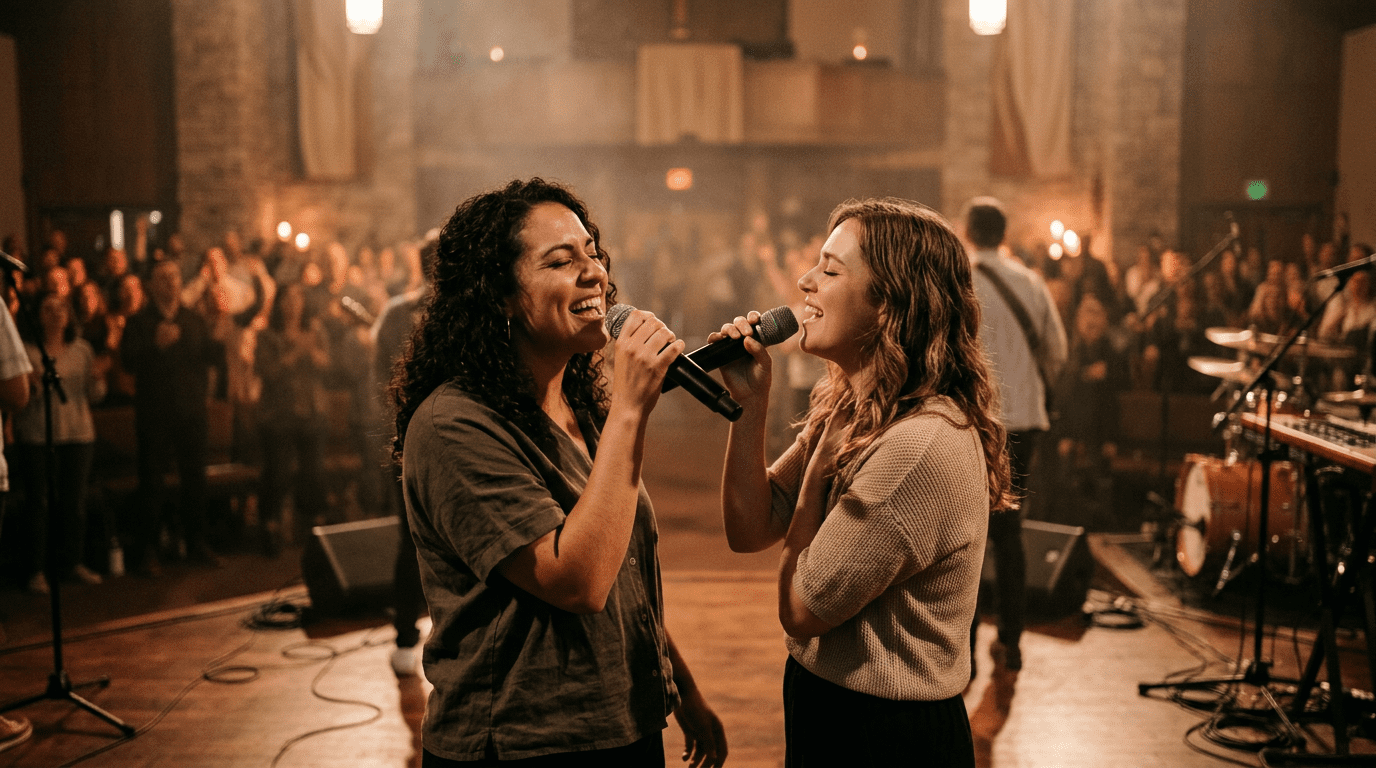
You know the moment. The worship leader calls out the harmony for the chorus. Everyone nods. The band kicks in. And you mouth the words because you have no idea what note to sing.
Or worse — you try the harmony and accidentally land back on the melody. Again. The singer next to you gives a polite smile. You both know what happened.
If you’ve ever learned a harmony from a live recording only to discover it was wrong, or quietly dropped out during the bridge because your part disappeared from your brain mid-song — you’re not alone. Most volunteer worship vocalists have never been taught how to sing harmony in worship. They’ve been told to “just sing a third above” with zero explanation of what that means.
This guide changes that. Practical steps. No music theory degree required. Just a clear path from melody-only singer to confident harmony vocalist.
Key Takeaways
- How to sing harmony in worship starts with understanding intervals — thirds, fifths, and octaves — and knowing which ones show up most in worship music
- You don’t need perfect pitch to hold a harmony part. You need a reliable system for learning and locking in your note before Sunday
- The biggest reason vocalists lose their harmony mid-song is insufficient isolation during practice — they learned their part buried under the full mix
- Confidence as a harmony singer comes from preparation, not talent. Preparation is rehearsable.
Table of Contents
- Why Harmony Matters in Worship
- Understanding Intervals: Thirds, Fifths, and Octaves
- How to Find Your Harmony Part
- The Difference Between Melody, Harmony, and Ad-Libs
- Common Worship Harmony Patterns
- How to Practice Harmony at Home
- Blending with Other Vocalists
- What to Do When You Lose Your Part Mid-Song
- Building Confidence as a Harmony Singer
- Frequently Asked Questions
- Start Singing Harmony in Worship with Confidence
Why Harmony Matters in Worship
Harmony isn’t about showing off. It’s about fullness.
When a worship team sings in unison, it sounds fine. When that same team locks into two or three-part harmony, the room changes. The sound gets wider. Richer. The congregation feels it even if they can’t name what happened.
Think about the bridge of “What A Beautiful Name” or the chorus of “Goodness of God.” Those moments land because the vocal parts stack. One voice carries the melody. The others surround it. That’s what pulls a congregation from singing along to actually worshiping.
Learning how to sing harmony in worship isn’t about being the best singer on the team. It’s about serving the song. The melody says the words. The harmony says the feeling.
Understanding Intervals: Thirds, Fifths, and Octaves
Before you can sing a harmony, you need to understand what you’re actually singing. Here’s the short version — no textbook required.
An interval is the distance between two notes. In worship vocal harmony, three intervals do most of the work:
Thirds. This is the most common harmony interval in worship music. A third sits two scale steps above or below the melody. If the melody sings “C,” the harmony sings “E” (a third above) or “A” (a third below). Thirds sound warm and natural. They’re the reason 3 part harmony worship arrangements feel full without sounding cluttered.
Fifths. A fifth is five scale steps above the melody. It sounds open and powerful. You’ll hear fifths in big chorus moments where the arrangement needs width. They’re less common than thirds but show up in key worship songs, especially during builds.
Octaves. Same note, different register. Singing an octave above or below the melody adds depth without adding a new harmonic color. Male and female vocalists often naturally sing in octaves when they sing the melody together.
Most worship singing tips overcomplicate this. If you can hear the melody and find the third above or below it, you can sing harmony on 80% of worship songs. That’s the interval to master first.
How to Find Your Harmony Part
This is where most vocalists get stuck. They know harmony exists. They just don’t know how to find their specific note.
Step 1: Sing the melody first. You can’t harmonize what you don’t know. Learn the melody cold. Every rhythm. Every syllable. If you can’t sing the melody without thinking, you’re not ready for harmony.
Step 2: Listen for the harmony in the recording. Play the original studio version — not a live recording, not a cover. Studio recordings have clean, intentional vocal arrangements. Live versions often have ad-libs and variations that will send you down the wrong path.
Step 3: Isolate the harmony part. This is the step that changes everything. If you’re trying to pick out a harmony line buried under a full band mix, you’re guessing. You need to hear the harmony part by itself. Worship Online lets you solo the vocal harmony from the original recording using a built-in mixer. You hear your exact part — isolated from everything else. No guessing. No rewinding the same three seconds of a YouTube video hoping to catch the note.
Step 4: Sing along with just the harmony. Once you can hear the isolated part, sing with it. Repeat it. Loop the section until your voice finds the note without searching for it. That’s how to sing harmony in worship — through repetition with a clean reference, not through guesswork.
The Difference Between Melody, Harmony, and Ad-Libs
These three things get confused constantly on worship teams. Here’s the distinction.
Melody is the main vocal line. It’s what the congregation sings. It carries the words. In most worship arrangements, the worship leader sings the melody.
Harmony is a second (or third) vocal line that moves alongside the melody at a fixed interval. It follows the same rhythm and lyrics. It doesn’t draw attention to itself. Good worship vocal harmony disappears into the song. You feel it more than you hear it.
Ad-libs are vocal fills, runs, or improvisations that happen between phrases or over sustained notes. They’re rhythmically independent from the melody. They draw attention. And they’re the number one source of vocal clutter on worship teams.
If you’re a harmony singer and you start adding runs or changing your rhythm, you’ve left your post. The harmony part serves the song by staying steady. It’s not the place for personal expression. Save that for the moments when the arrangement calls for it.
Common Worship Harmony Patterns (Verse vs. Chorus)
Worship songs follow predictable patterns. Once you see them, you’ll know how to sing harmony in worship before you even hear the specific part.
Verses are usually melody-only or light harmony. Many worship arrangements keep the verse stripped back — one voice, maybe two. If you’re a harmony singer, this is often where you rest or sing in unison with the lead. Don’t force a harmony where the arrangement doesn’t call for one.
Choruses are where harmony opens up. Most worship choruses use two or three-part harmony, typically in thirds. The harmony enters with the full band and adds the emotional lift the chorus needs. This is your moment.
Bridges are where 3 part harmony worship arrangements shine brightest. The bridge is the emotional peak. The vocal stack widens. A third part often enters here — sometimes a fifth above the melody or a low harmony underneath. If your team has three vocalists, the bridge is where all three parts should be locked in.
Tags and endings often simplify. The final repeat usually pulls back to unison or a simple two-part harmony. Follow the arrangement. Don’t keep stacking when the song is winding down.
How to Practice Harmony at Home
Here’s the honest truth. You cannot learn harmony during rehearsal. There’s too much sound. Too many instruments. Too much pressure. If you’re trying to find your note while the band plays, you’re already behind. (For more on making rehearsals productive, see our worship rehearsal tips.)
Harmony gets learned at home. Alone. With a clear reference.
Start by listening to the song three times through, focusing only on the vocal parts. Don’t worry about the band. Just listen to what the voices are doing. Where does the harmony enter? Where does it drop out? What interval is it — a third above, a third below?
Then isolate your part. This is where most vocalists hit a wall. The harmony is buried in the mix. You can hear it’s there, but you can’t grab the note. This is exactly why Worship Online built a solo/mute mixer into every vocal tutorial. You pull up the song. You mute everything except the harmony. You loop the chorus. You slow it down if you need to. You sing along until the part is in your body, not just your head.
That’s the difference between learning how to sing harmony in worship from a random live recording and learning the specific harmony from the original arrangement. One is guessing. The other is preparation.
Practice the harmony part until you can sing it while the melody plays without drifting. That’s your test. If the melody pulls you off your note, you haven’t learned it well enough yet.
Blending with Other Vocalists
Singing the right note is half the job. Singing it so it blends is the other half.
Match vowel shapes. If the lead vocalist sings “praise” with a wide vowel, your harmony needs the same shape. When vocalists use different vowel sounds on the same word, the blend breaks apart. Listen to how the lead vocalist forms each word and mirror it.
Match volume. Harmony should sit underneath the melody, not compete with it. A good rule: sing your harmony at about 70% of the lead’s volume. If you can hear your harmony louder than the melody in the monitor, pull back.
Match tone. This is the subtle one. If the lead is singing with a warm, breathy tone, don’t belt your harmony. If the lead opens up on the chorus, you open up too. The worship vocal harmony should feel like one voice with multiple notes, not multiple singers doing their own thing.
Watch your vibrato. Heavy vibrato on a harmony part makes the pitch wobble against the melody. Keep your tone straight and controlled, especially on sustained notes. Blend means sacrifice. Your individual sound serves the collective one.
What to Do When You Lose Your Part Mid-Song
It happens. Even to experienced singers. The band hits a big moment, someone near you sings the melody loud, and suddenly you can’t find your note anymore.
Don’t panic. Don’t stop singing. Here’s what to do.
Drop to the melody. If you lose your harmony, sing the melody until you find your footing. Singing melody is always better than singing a wrong note or going silent. The congregation won’t notice. The team won’t notice. A wrong harmony note — everyone notices.
Wait for a phrase reset. Most worship melodies have natural landing points — the top of a new line, the start of a new section. Use that moment to re-enter your harmony. You know the first note of your part in the chorus. Wait for it. Jump back in clean.
Use your monitor. If your in-ear mix has any vocal reference, lean into it when you’re lost. Even a faint harmony in the monitor can pull your ear back to the right note. If your monitor mix doesn’t include a vocal reference, talk to your sound tech about adding one. This is one of the most overlooked worship singing tips for harmony vocalists.
The key to recovering mid-song is knowing how to sing harmony in worship well enough that the phrase resets are automatic. When you’ve practiced the part at home — isolated, looped, and memorized — your muscle memory pulls you back even when your ear gets confused.
Building Confidence as a Harmony Singer
Confidence doesn’t come from talent. It comes from clarity.
When you know exactly what note to sing on every line of every song, you stop second-guessing. You stop singing quietly. You stop watching the lead vocalist’s mouth hoping for a cue. You just sing.
Here’s how to build that confidence systematically:
Learn one song at a time. Don’t try to learn harmony on every song in the setlist at once. Pick one. Get it locked in. Perform it on Sunday. Feel what it’s like to nail your part. Then add the next one.
Record yourself. Sing your harmony part over the recording and listen back. You’ll hear immediately if you’re drifting toward the melody or if your pitch is off. It’s uncomfortable the first time. It’s clarifying every time after.
Know the arrangement, not just the notes. Know when to enter. Know when to drop out. Know which sections are unison and which are harmony. When you understand the full vocal map of the song, you stop being surprised. Surprises kill confidence.
9,000+ worship teams and 17,000+ musicians use Worship Online to prepare before rehearsal. For vocalists learning how to sing harmony in worship, this means hearing your exact vocal part isolated from everything else, looping the harmony section until it’s locked in, and learning the specific harmony from the original recording — not guessing from a live version where the vocalist improvised half the part.
That’s the system. Clarity creates confidence. Confidence creates freedom. And freedom is where worship actually happens.
Frequently Asked Questions
How do I know if I should sing high harmony or low harmony?
Start with your natural range. If you’re a soprano or higher tenor, try the harmony above the melody (a third up). If you’re an alto or lower voice, try the harmony below (a third down). There’s no rule that says you must sing one or the other. The right part is the one you can hold consistently without straining. If both feel comfortable, ask your worship leader which part the team needs covered.
Can I learn to sing harmony if I’ve never had vocal training?
Yes. Most harmony singing in worship doesn’t require advanced technique. It requires a good ear, a clear reference recording, and repetition. If you can match a pitch — if you can sing along to the radio and stay on the note — you can learn harmony. The challenge isn’t ability. It’s having the right resource to learn from. Random YouTube videos teach you someone’s interpretation. Album-accurate tutorials teach you the actual part.
What’s the easiest way to start learning 3 part harmony worship vocals?
Start with two parts first. Get comfortable holding a third above or below the melody on a song you already know well. Once that feels stable, add the third part — usually a fifth above or an octave below. Three-part harmony works best when each singer has their part memorized independently before combining. If all three vocalists learn their isolated parts at home and bring them to rehearsal ready, locking in together takes minutes instead of the whole session.
Why do I keep drifting back to the melody when I try to sing harmony?
Because the melody is louder and more familiar. Your ear gravitates toward the strongest signal. This is normal. The fix is isolation. Practice your harmony part alone — without the melody playing — until it feels like its own song. Then add the melody back in gradually. When your body knows the harmony as well as it knows the melody, the pull disappears. This is the core skill behind how to sing harmony in worship without getting lost.
How many worship songs should I learn harmony on before Sunday?
Start with one or two per setlist. If your team plays five songs on Sunday, pick the two where harmony matters most — usually the chorus of the biggest song and the bridge of the most dynamic one. Sing melody on the rest. As your ear develops and your practice system gets tighter, you’ll naturally add more. Trying to harmonize on every song before you’re ready leads to shaky parts across the board instead of strong parts where they count.
Start Singing Harmony in Worship with Confidence
Learning how to sing harmony in worship is not about having a gifted ear. It’s about having a system. Know the intervals. Isolate your part. Practice until the note is automatic. Blend with your team. And when you lose it mid-song, drop to melody and re-enter clean.
It’s not a talent problem. It’s a preparation problem. And preparation is something you can control every single week.
The vocalists who sing harmony with confidence on Sunday aren’t more talented than you. They’re more prepared. They heard their exact part before rehearsal. They practiced it in isolation. They walked in knowing what to sing on every line. That’s the difference.
Stop guessing your part from live recordings. Stop mouthing the words during the bridge. Stop hoping your ear will figure it out on Sunday morning.
Start your free trial of Worship Online. Your whole team gets album-accurate tutorials for electric guitar, acoustic guitar, bass, drums, keys, and vocals for 800+ worship songs. Every musician learns their exact part before rehearsal. Rehearsals become about refining, not reteaching. Start your free, no-risk 14-day trial.