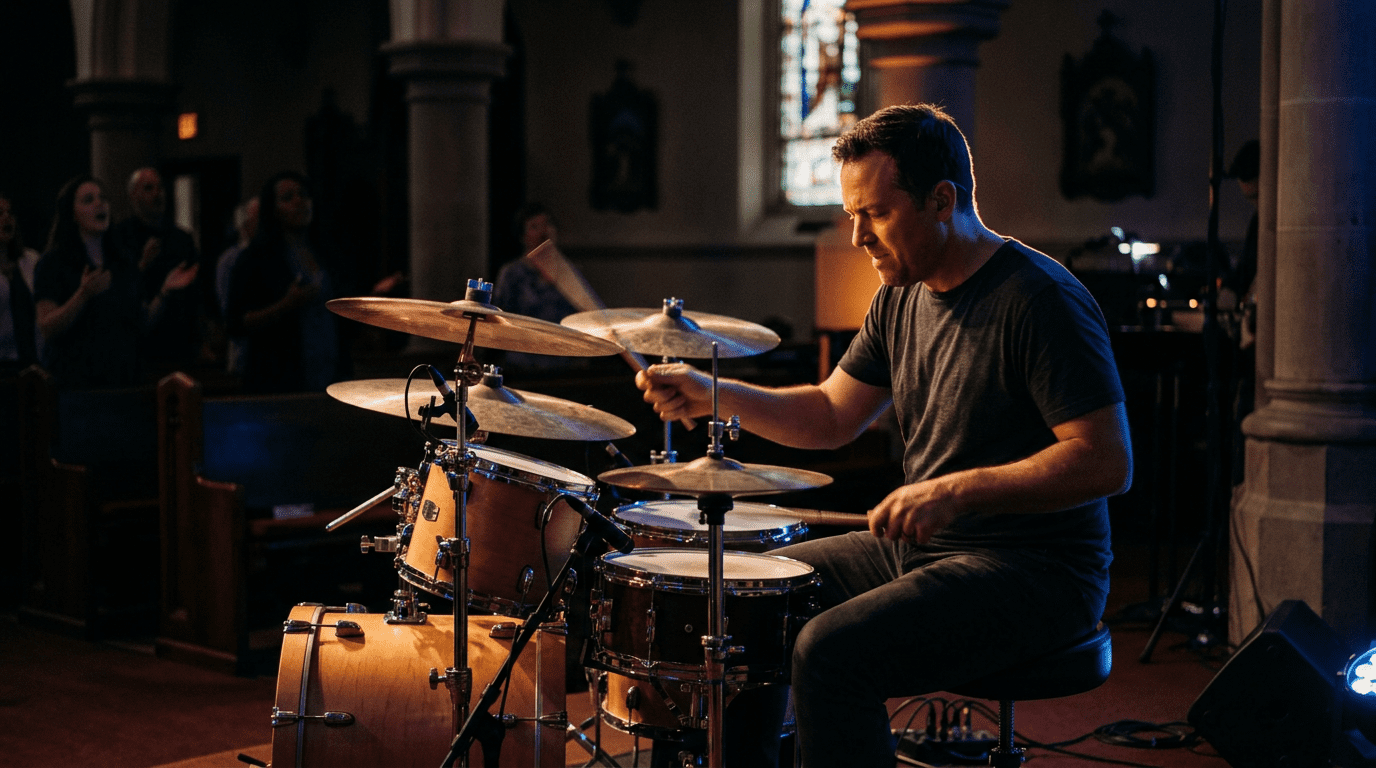
You know the moment. The worship leader turns around after the first song and says, “Hey, can you play a little quieter?” You nod. You pull back. But you’re not sure how much quieter they mean. And now you’re thinking about volume instead of worship.
Or maybe it’s the click track. Your worship leader just introduced one. Everyone else seems fine. You’re white-knuckling through the verse trying not to rush the fill into the chorus. Nobody told you how to actually practice with a click.
This worship drumming guide is for you. The volunteer church drummer who wants to serve well but feels stuck between “too much” and “not enough.” You don’t need a degree in percussion. You need clarity on what worship drumming actually requires, and a system to get there.
Key Takeaways
- A complete worship drumming guide covering dynamics, click tracks, patterns, fills, gear, and weekly practice
- Why dynamics matter more than chops in a church context
- How to start playing with a click track without losing your mind
- A practical system for learning drum parts from recordings instead of guessing
Table of Contents
- The Drummer’s Role in Worship
- Playing With a Click Track
- Dynamics — The Most Important Skill in Worship Drumming
- Ghost Notes, Rim Clicks, and Cross-Stick Techniques
- Common Worship Drum Patterns
- When to Play Fills and When to Hold Back
- How to Learn Drum Parts From Recordings
- Building a Weekly Practice Routine
- Gear Basics for Church Drummers
- Frequently Asked Questions
- Your Worship Drumming Guide Starts Here
The Drummer’s Role in Worship
Here’s the uncomfortable truth most church drummers need to hear: you’re not the star. You’re the foundation. Everything the band does sits on top of what you play. When you rush, the whole team rushes. When you drag, everyone drags with you.
Your job is to make the band sound better. That means serving the song, not showcasing your skills. The best worship drummers play what the song needs. Not more. Not less. Exactly what the moment calls for.
Think of it this way. The congregation doesn’t notice great drumming. They notice bad drumming. When you’re doing your job well, people feel it without thinking about it. The groove is steady. The transitions are smooth. The dynamics shift naturally. That’s the goal.
If you come from a rock or pop background, this is a mindset shift. In a band, you compete for attention. In worship, you create space for everyone else. This worship drumming guide will help you make that transition.
Playing With a Click Track
If your worship leader just introduced a click track and you feel like you’re drowning, you’re not alone. Most volunteer drummers have never played with one. The good news: it’s a skill, not a talent. You can learn it.
Start at home. Not at rehearsal. Pick a song you already know well. Set a metronome to the song’s BPM and play along. Don’t try to learn a new song and a click at the same time. That’s two problems at once.
Here’s what most church drummer guides won’t tell you. The click will feel like a cage at first. That’s normal. After two to three weeks of consistent practice, it starts to feel like a rail you lean on. Then it becomes invisible. You stop hearing it as a separate thing. It just becomes part of the groove.
Practical tips for getting comfortable:
- Practice with the click at a slower tempo first. Drop 10-15 BPM below the actual song tempo. Get locked in, then bring it back up.
- Put the click in only one ear if you’re using in-ear monitors. Leave the other ear open for the band.
- Focus on locking your kick and snare to the click. Let the hi-hat and ghost notes breathe naturally around it.
- Don’t chase the click. If you fall behind, don’t speed up to catch it. Reset on the next downbeat.
Playing drums in worship with a click track separates prepared drummers from reactive ones. It’s worth the discomfort.
Dynamics — The Most Important Skill in Worship Drumming
If you only take one thing from this worship drumming guide, make it this: dynamics matter more than fills, more than speed, more than any technique.
Most worship songs move through a clear emotional arc. Quiet verse. Building pre-chorus. Full chorus. Stripped-back bridge. The drums tell the congregation where they are in that arc. When you play the verse at the same volume as the chorus, the song has nowhere to go.
Here’s a framework. Think of your playing in four levels:
- Level 1: Cross-stick or rim click on the snare. Kick on 1 and 3. Hi-hat barely breathing. This is your verse or intro level.
- Level 2: Light snare hit on 2 and 4. Kick pattern opens up slightly. Hi-hat is steady but restrained.
- Level 3: Full snare. Open hi-hat on the and of 4. Kick is driving. This is your chorus.
- Level 4: Ride cymbal or crashes. Full kit. Everything open. Reserve this for the biggest moment in the song.
The key is contrast. If everything is loud, nothing is loud. Your worship leader isn’t asking you to play quieter because you’re bad. They’re asking because the song needs room to breathe. And that room comes from you.
Ghost Notes, Rim Clicks, and Cross-Stick Techniques
These three techniques are what separate a worship drummer from someone who just plays beats. They give you tools for those quiet moments where a full snare hit would swallow the room.
Ghost notes are extremely soft snare hits between your main strokes. They add texture without adding volume. Think of them as the drummer’s whisper. You feel them more than you hear them. Practice by playing a basic groove and adding ghost notes on the “e” and “a” of each beat at about 20% of your normal snare volume.
Rim clicks (or side stick / cross-stick) are played by laying the stick across the drumhead with the tip touching the center and striking the rim with the butt end. This produces a sharp, woody “click” instead of a full snare sound. It’s the default verse sound for most worship songs.
If you learn nothing else from this church drummer guide, learn to play a solid rim click groove. It’s the sound of 80% of worship verses. Practice switching between rim click in the verse and full snare in the chorus until the transition is seamless.
Common Worship Drum Patterns
Most contemporary worship songs follow predictable structures. Once you recognize the patterns, you stop guessing and start serving the arrangement.
Verse pattern: Rim click on 2 and 4. Kick on 1 and the “and” of 2. Closed hi-hat in eighth notes. This is your bread and butter. Simple. Steady. Musical.
Chorus pattern: Full snare on 2 and 4. Kick opens up to match the bass guitar. Understanding how bass and drums work together will help you lock in with your bassist. Hi-hat may switch to open on the “and” of 4 for lift. Some choruses call for the ride cymbal instead of the hi-hat for a warmer, more sustained sound.
Bridge pattern: This varies the most. Some bridges strip all the way down to kick and cross-stick. Others build to the biggest moment in the song. Listen to the recording. The bridge is where most worship drums tips go wrong because drummers guess instead of learning the actual part.
Build / pre-chorus: Eighth notes on the floor tom or a snare roll building in volume. Crash cymbal on the downbeat of the chorus. The build is about momentum, not complexity.
The more songs you learn, the more these patterns become second nature. You stop thinking about what to play and start feeling it.
When to Play Fills and When to Hold Back
This is where most volunteer church drummers get into trouble. You know a fill that sounds great on its own. So you play it. But it lands in a quiet moment and everyone on stage flinches.
The rule is simple: fills serve transitions. A fill should move the song from one section to the next. Verse to chorus. Chorus to bridge. Pre-chorus to chorus. If you’re playing a fill in the middle of a verse, ask yourself why. If the answer is “because I can,” that’s the wrong reason.
Keep fills short. Two beats is enough for most worship transitions. A one-beat fill into a chorus crash often hits harder than a full-bar fill that nobody asked for.
Here’s one of the best worship drums tips that will serve you for years: the fill you don’t play is often the most musical choice. A simple crash on the downbeat of the chorus can be more powerful than the most creative fill. Let the song breathe. Let the band make the transition together.
When you do play fills, match the energy of the next section. A big fill into a quiet bridge is jarring. A gentle tom roll into a full chorus doesn’t create enough lift. Match the fill to where the song is going, not where it’s been.
How to Learn Drum Parts From Recordings
Here’s what most church drummers do: they listen to the full song on Spotify, try to catch the drum part underneath everything else, and walk into rehearsal hoping they got it right. That’s not preparation. That’s guessing.
The problem isn’t effort. It’s that you can’t hear your part clearly. The drums are buried under guitars, keys, and vocals in a finished mix. You’re trying to learn from a recording that was mixed for listeners, not drummers.
This is where a tool like Worship Online changes the game for your practice. Instead of guessing what the kick pattern is on verse two, you hear just the drums. The solo/mute mixer lets you isolate the drum part from 800+ worship songs. Browse our top worship drum tutorials to start learning your favorite songs fast. You hear every ghost note, every kick placement, every dynamic shift.
You can also loop the hard section. That bridge transition you keep fumbling? Loop it. Play it ten times. Slow it down with the tempo control until your hands know it. Then bring it back to full speed. This is how you learn the exact drum part from the recording instead of inventing fills that don’t fit the arrangement.
9,000+ worship teams already use this system. It works because it solves the real problem: hearing your specific part clearly enough to actually learn it.
Building a Weekly Practice Routine
You practice one to three hours a week. That’s the reality for most volunteer church drummers. You can’t waste that time on unfocused noodling. You need a system.
Here’s a weekly worship drumming guide for your practice:
Day 1 (30-45 minutes) — Learn the parts. Get the setlist. Listen to each song. Identify the sections and the dynamic levels. Write down any tricky transitions. If you can hear isolated drums, use that. If not, listen closely and chart out the patterns.
Day 2 (30-45 minutes) — Practice with the click. Play through each song at tempo with a metronome. Slow down the hard parts. Focus on transitions between sections. Don’t just play the beats — practice the shifts between verse and chorus, chorus and bridge.
Day 3 (15-30 minutes) — Run the set. Play the full setlist top to bottom. No stopping. Simulate Sunday. This is where you find out if you actually know the songs or if you’ve been fooling yourself.
If you only have one day, combine days 1 and 2. Listen and play. But always run the full set at least once before Sunday. That final run-through is where confidence comes from.
Gear Basics for Church Drummers
You don’t need a $3,000 kit to play drums in worship well. Check out our roundup of the best drum sets for church and worship at every price point. But a few gear choices make a real difference in how you sound in a church context.
Sticks: Use a lighter stick for worship. Our guide to picking the right drumsticks for worship goes deeper on this topic. A 7A or a Vic Firth SD1 gives you control at low volumes without fighting the stick. If you’re used to 5B or 2B sticks from playing rock, the switch will feel strange for a week. Then you’ll wonder why you ever used heavy sticks in church.
Drum heads: Coated heads on the snare (like a Remo Ambassador Coated) give you a warmer, more controlled sound. Clear heads are brighter and louder. For worship, warmth wins. On toms, two-ply heads like Evans G2s reduce overtones and keep the sound focused.
Muting: Most church rooms are not treated for acoustics. Your drums ring longer than you think. Moongels on the toms and snare tame the sustain. A small pillow or blanket in the kick drum controls the boom. Less ring means clearer sound at lower volumes.
Cymbals: Dark, thin cymbals are your friend. They wash and decay faster than bright, heavy ones. If your sound tech keeps asking you to play quieter, your cymbals might be the biggest offender. A set of low-volume cymbals (like Zildjian L80s) is worth considering if your stage volume is a constant battle.
Good gear doesn’t replace good playing. But the right setup removes barriers between you and the sound your worship team needs. No worship drumming guide is complete without addressing your kit. Get the gear right, and your technique has room to shine.
Frequently Asked Questions
How do I play quieter without losing feel?
Switch to lighter sticks, use rim clicks during verses, and focus on ghost notes for texture. Playing quieter isn’t about holding back. It’s about using different techniques that produce less volume while keeping the groove alive. Practice at low volumes deliberately. Most drummers only practice at full volume and then struggle to scale down on Sunday.
What’s the best way to learn worship drum parts?
Listen to isolated drum tracks when possible. If you can’t isolate the drums, listen to the full recording on headphones and focus on the kick and snare placement section by section. Chart out the form: intro, verse, chorus, bridge. Note the dynamic level of each section. Worship Online gives you album-accurate drum tutorials with a solo/mute mixer so you hear just the drums from 800+ songs.
Should I use a drum shield or electronic kit at church?
Both are valid. A shield helps contain volume in smaller rooms. An electronic kit gives your sound tech complete control. Neither is a substitute for learning dynamics. If you play with poor dynamics on an electronic kit, it still sounds wrong through the PA. The instrument changes. The skills in this worship drumming guide stay the same.
How many songs should I prepare each week?
Most worship sets are four to six songs. Prepare all of them. Start with the one you know least. Give yourself at least three days between getting the setlist and Sunday. If you’re scrambling Saturday night, the problem is timing, not ability.
What if I’m the only drummer and I can’t take a week off?
Talk to your worship leader about developing a second drummer. Offer to mentor someone. Burnout is real for church drummers, and playing drums in worship every single week without rest leads to going through the motions. A rotation protects your passion and builds the team.
Your Worship Drumming Guide Starts Here
Good worship drumming isn’t about chops. It’s about clarity. Knowing what to play, when to play it, and when to hold back. It’s about dynamics, preparation, and serving the song above your own instincts.
If you’ve been the drummer who gets told to play quieter every Sunday, now you know why. And you know what to do about it. If you’ve never played with a click, this worship drumming guide gave you a roadmap. If you’ve been guessing your parts from Spotify, there’s a better way.
It’s not a talent problem. It’s a system problem. And when the system is right, everything else falls into place.
Start your free trial of Worship Online. Your whole team gets album-accurate tutorials for electric guitar, acoustic guitar, bass, drums, keys, and vocals for 800+ worship songs. Every musician learns their exact part before rehearsal. Rehearsals become about refining, not reteaching. Start your free, no-risk 14-day trial.