Guitar gear culture is a fascinating world where the nuances of tone can become nothing short of an obsession for many players.
Discussions about pedals, amps and guitars using ambiguous descriptors such as “transparent”, “breakup”, “touch sensitive”, and “feel” plague internet forums and social media accounts.
With so many opinions, and little experience or testing, how does one know if a Klon Centaur is worth the roughly $2,800 to $5,900 a used one sells for on Reverb at the time of writing, depending on the version?
Or if a vintage Fender amp is worth double the price of a reissue?
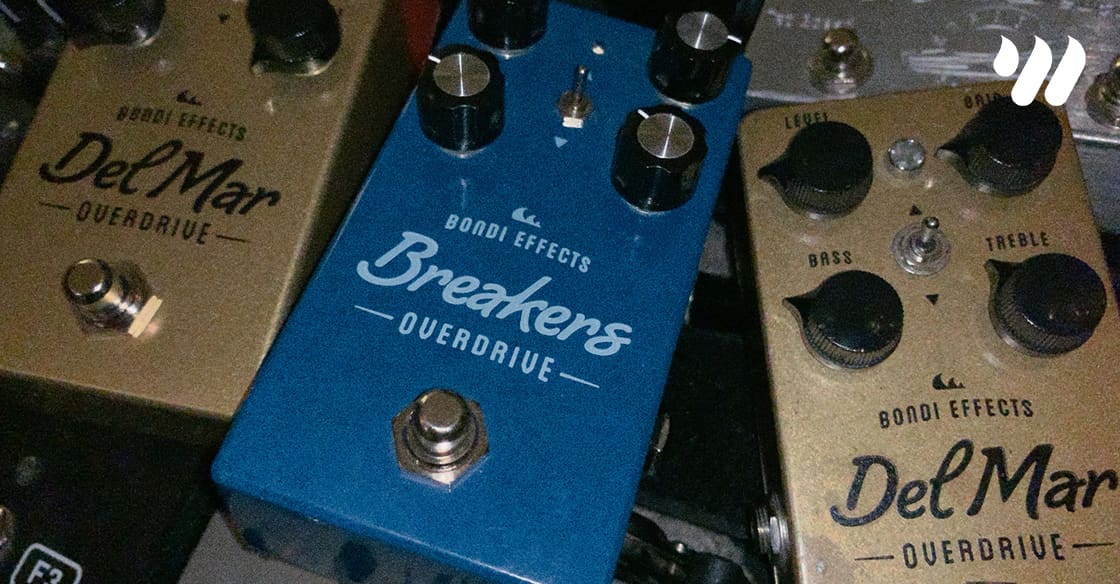
Or if a Del Mar is better than the Breakers?
The Bondi Hype
The Bondi Del Mar is one overdrive pedal that has made a name for itself in the worship community. I actually have used it quite a bit and love its flexible controls.
When the builder decided to improve the circuit and rebrand the “Del Mar” as the “Breakers” overdrive, the gear community freaked out. Asking prices for the now discontinued pedal shot up. Reverb reported Del Mar listings priced at more than $1,200 for a pedal that once retailed for $199, and some people began to describe it as the new Klon.
Long story made short, the owner decided to reissue a limited batch of the Del Mar with some slight changes (V2). I got my hands on all 3 versions of the pedal and want to let you decide if any of them are worth the prices that are charged.
Bondi Breakers vs Del Mar: Where Each Pedal Stands Today
Bondi told Reverb News that it discontinued the original Del Mar after three years and replaced it with the Breakers, which “sounds like what I initially envisioned the Del Mar to sound like.” Here is where the pedals stand now.
| Pedal | Status | Price at the time of writing |
|---|---|---|
| Breakers | Not listed in Bondi’s own store | About $99 to $157 used (Reverb price guide) |
| Del Mar (original) | Discontinued | About $188 to $287 used (Reverb price guide) |
| Del Mar mk2 | The version Bondi sells today | $299 new from Bondi |
Bondi says the Del Mar mk2 keeps the Del Mar sound with a quieter circuit: 22dB less noise than the mk1, a toggle switch that sets headroom and drive character (the lower position adds a “Bluesbreaker” style of clipping), and an active tone stack with 15dB of boost or cut.
The pedals in my test are the original Del Mar (V1), its limited reissue (V2) and the Breakers. The Breakers, the pedal that started all the talk, now sells used for roughly a third to a half of what a new mk2 costs.
The Experiment
I recorded various clips of different types comparing the different pedals side by side. I used a looper so that there was more consistency in playing, to remove that as a variable in audible change as much as possible. No other effect, such as a compressor pedal, was used. Just guitar, overdrive, amp. If you added a compressor pedal into the mix, I would say the differences would probably be even smaller.
Some of you might raise flags in all of this claiming, “The feel and touch sensitivity matters and must be different!” Well, it’s not. I don’t know what else to say.
Many people begin comparing pedals by setting the knobs at identical placements or all at noon. This is a rather terrible way to judge them because it exposes tonal range more than tonal character. For this reason, I dialed in each pedal to sound as similar to the other as possible. This shows a real-world application of how similar pedals really are.
Test 1: Single Chord Rhythm, Lower Gain, Switch Up
For this first test, I dialed the pedals to settings I’ve personally used before and played consistent chords. This helps avoid confusing musical differences as tonal variation.
Results:
1) Breakers (Level @1, Gain @1:30, Bass @10, Treble @11)
2) V1 (Level @10, Gain @10, Bass @9, Treble @12)
3) V2 (Level @12, Gain @10, Bass @9, Treble @12)
Test 2: Open String Arpeggio, Lower Gain, Switch Up
Same settings as test one but with arpeggiated playing.
Results: V1, Breakers, V2
Test 3: Switch Up vs Switch Down
When one setting is described as a Tube Screamer and the other as a Bluesbreaker, you would think the differences would be diverse. Yes, the down setting may be slightly louder and a hair less compressed, but the difference is so minuscule that I’d say it doesn’t matter. All I did was raise the volume of the up setting to compensate for the volume difference. When playing outside of the looper, could I tell a compression difference? Not really, and I’m picky.
Results: V1 Up, V1 Down, same settings as previous tests
Test 4: Lead, Higher Gain, Switch Down
Going to the opposite end of the spectrum, here’s the switch down with higher gain on the neck pickup. I was a bit surprised by the settings I ended up dialing in. The Breakers stays very clean until a certain spot and then gets a lot of gain on tap, while the V1’s range is rather clean and loud in comparison.
Results:
1) V1 (Level @10, Gain @5, Bass @12, Treble @2)
2) V2 (Level @11, Gain @2, Bass @12, Treble @2)
3) Breakers (Level @10, Gain @2, Bass @12, Treble @2)
Test 5: Single Chord Rhythm, Medium Gain, Del Mar vs Tube Screamer
I have an OD820 (Maxon’s Overdrive Pro, which Maxon builds on its 808 circuit) that I wanted to use to show even further how similar overdrives can be. Maxon lists it at $199, though it shows as sold out on Maxon’s site at the time of writing.
Results: V1, 820, V1, 820
My Conclusion
Yes, the V1 may have slightly more bass and be louder at lower gain settings, but in real-world application I’d argue you could dial in any of these to the settings you’d prefer and you’d be fine.
My hope with this experiment is to show players that a lot of the nuances we obsess over, and ultimately pay good money for, may not be worth it. You don’t need $1,200, or even $300, for good overdriven tone. I’d argue that you’d be fine with an ordinary Tube Screamer if you’re a good player and know how to dial in the rest of your rig.
Here are my concluding views on tone and why I’m doing this article:
- The nuances we think we hear or feel and get hung up on are overrated.
- Many of the differences people think they hear or feel from one piece of gear are largely psychological or could be matched with a slight tweak of settings.
- In a real-world application, the slight differences you may hear don’t matter a lot of the time.
- Musical gear is just a set of tools with different parameters that many times can be adjusted to sound incredibly similar, especially in the non-extreme settings that most people use.
- It’s about how you use the gear more than what version you buy and how much you spend.
- Many of the marketing and selling points of gear, such as, say… an overdrive’s clipping, are overemphasized because most pedals are clones, and products need some sort of differentiation to sell in an oversaturated market.
- Gear is important for inspiration and there’s nothing wrong with trying something new to keep things fresh and fun, just don’t buy something because the internet hypes it.
The money is better spent on your hands than your board. If you want a place to put that into practice, our worship guitar tutorials show you the exact parts from the album for 800+ songs, and you can try them with a free, no-risk 14-day trial.
Could you hear a difference? What pedals do you think are worth the high price? Let us know in the comments below.
Check out these similar posts!
- Worship Guitar Tone Master Class VIDEO SERIES
- Nick Mayer (Zach Williams) Guitar Rig Rundown
- The Most Surprising Guitar Secret for Sounding Massive
- Overdrive Pedals: Finding Your Tone
- The Ultimate Guide to Instrument Cables
- Bass Rig Setup & Building an Affordable Pedalboard with Tom Furby (Hillsong Y&F)
- How to Build Creative Guitar Sounds for Worship


Podcast: Play in new window | Download
Subscribe: RSS