Be honest. You’ve been playing the same four open chords for a year. G, C, D, Em. Every Sunday. Same strum pattern. Same sound. You watch the recording on YouTube and hear the electric guitar doing something you can’t quite figure out. So you just play louder and hope nobody notices the gap.
You’re not alone. Most volunteer guitarists in worship teams live here. Not because they lack talent. Because nobody showed them what to actually play beyond the chord chart. Worship guitar for beginners isn’t about learning more chords. It’s about learning your specific part.
This guide covers the essential techniques that will make you sound like you belong on that stage. Real chord shapes, capo positions, strumming patterns, dynamics, and how to learn the exact guitar part from any worship song. Everything here works for acoustic and electric. Everything here fits into 1-3 hours of weekly practice.
Key Takeaways
- Essential open chords, capo positions, and strumming patterns every beginner worship guitar player needs
- How to move beyond chord charts and learn the actual guitar part from recordings
- The difference between acoustic and electric roles in a worship band — and why it matters
- A realistic weekly practice routine that prepares you for Sunday in 1-3 hours
Table of Contents
- Why Chord Charts Aren’t Enough
- Essential Open Chords for Worship
- Capo Basics and Common Worship Positions
- Strumming Patterns That Work for Worship
- Electric vs Acoustic Roles in a Worship Band
- Dynamics — When to Play Loud, When to Pull Back
- How to Learn Parts from Recordings
- Easy Worship Guitar Techniques That Sound Professional
- Worship Guitar for Beginners: A Practice Routine for Sunday
- Frequently Asked Questions
- Worship Guitar for Beginners: Start Playing with Confidence
Why Chord Charts Aren’t Enough
Chord charts tell you what harmony to play. They don’t tell you how to play it. A chord chart says “G.” But the acoustic guitar on the recording is playing a G with a specific picking pattern. The electric guitar is playing two notes with delay. And the chart doesn’t mention either one.
This is where most worship guitar for beginners advice fails. It stops at chord names. But the difference between sounding like a beginner and sounding like you belong isn’t the chords. It’s the voicings, rhythms, and textures around those chords.
A chord chart is a starting point. Not a destination. If your whole preparation is reading letter names off a screen, you’re guessing. And guessing is why you feel lost up there every Sunday.
Essential Open Chords for Worship
The good news: contemporary worship music lives in a small number of keys. Master these open chord shapes and you’ll cover 80% of what your team plays.
The essential six: G, C, D, Em, Am, and A. These chords appear in nearly every worship song written in the keys of G, C, D, and A. If you only have time to work on six shapes, these are the ones.
Add these when you’re ready: Bm (barre or simplified), F (thumb-wrap or barre), Dm, and E. These open the door to songs in keys like B minor and F major that show up less often but still matter.
Here’s what most beginners miss. How you transition between chords matters more than the chords themselves. Practice switching G to C until there’s zero gap. Practice D to Em until your fingers move without thinking. Smooth transitions are what make a church guitar part sound polished. Choppy transitions are what make it sound amateur.
Capo Basics and Common Worship Positions
A capo lets you play open chord shapes in any key. If the song is in B-flat, you don’t need barre chords. Capo 3, play G shapes. Done.
Common capo positions for worship guitar for beginners:
- Capo 2: Play in the key of A using G shapes (gives you the key of A)
- Capo 3: Play G shapes for the key of B-flat
- Capo 4: Play G shapes for the key of B, or C shapes for the key of E
- Capo 5: Play G shapes for the key of C (useful when the piano is in C and you want open voicings)
One rule to remember: the capo number plus the open chord shape equals the actual key. If your worship leader says “we’re in B-flat,” put the capo on 3 and play G, C, D, Em shapes. You get the full ring of open strings without wrestling barre chords.
Ask your worship leader what key each song is in before rehearsal. If you don’t know the key until you walk in the door, you’ve already lost prep time. This is a system fix, not a skill fix. For more on getting setlist information early, see these worship rehearsal tips.
Strumming Patterns That Work for Worship
Most beginner worship guitar players default to a straight down-strum on every beat. It works. But it sounds flat. Here are three patterns that cover almost every worship song.
Pattern 1 — The worship standard: Down, down-up, up-down-up. This eighth-note pattern with a syncopated feel drives most mid-tempo worship songs. Think “Build My Life” or “Who You Say I Am.”
Pattern 2 — The slow build: Whole-note downstrums. One strum per chord, letting it ring. Use this for verses and quiet moments. Simple doesn’t mean lazy. It means intentional.
Pattern 3 — The driving eighth: Steady down-up-down-up on eighth notes with a palm mute. This works for energetic choruses and bridge sections. Keep your wrist loose. Tension kills your tone and your endurance.
Here’s the real beginner worship guitar tip most people skip: match the energy of the song, not the complexity. If the verse is quiet and intimate, one slow strum says more than a busy pattern. If the chorus explodes, open up your strumming. The pattern matters less than the feel.
Electric vs Acoustic Roles in a Worship Band
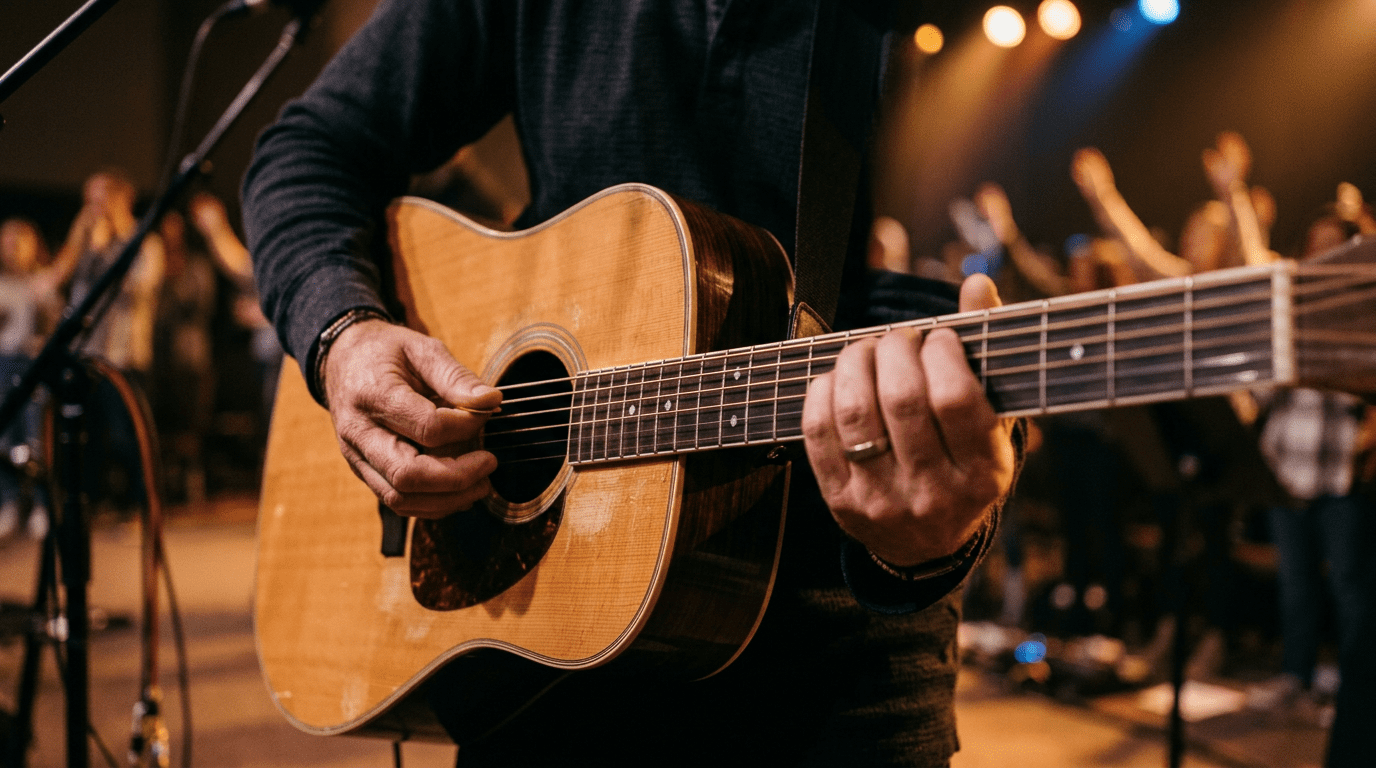
If you play acoustic guitar in a worship band, your job is rhythm and foundation. You’re the engine. Steady strumming, clean chord changes, locked in with the drummer’s hi-hat. You don’t need to be flashy. You need to be reliable.
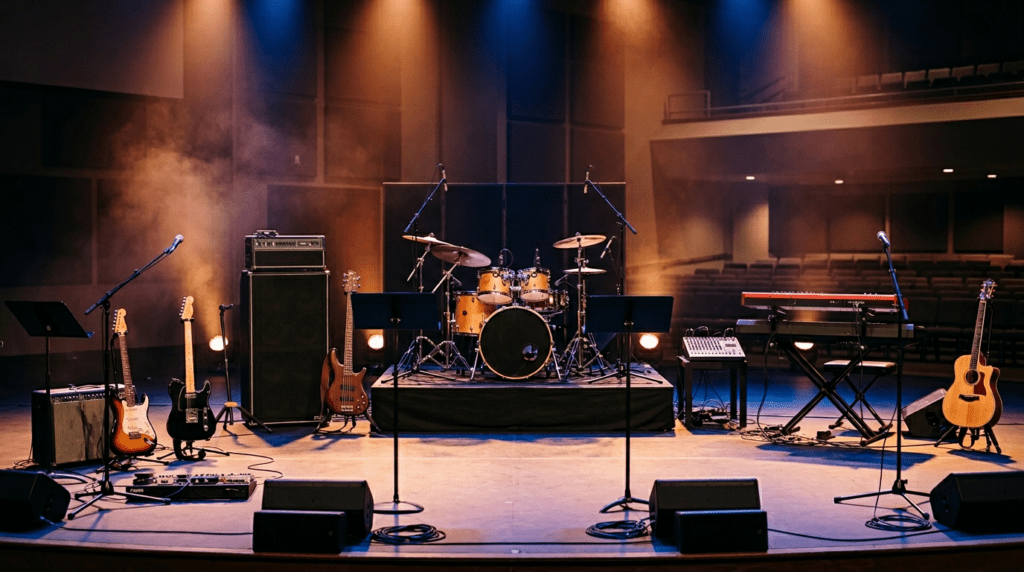
If you play electric, your role is completely different. Electric guitar fills space with textures. Delay-driven arpeggios. Single-note lines. Swells with a volume knob or pedal. You are not strumming open chords on electric. If you are, you’re stepping on the acoustic player’s role.
This is one of the biggest gaps in worship guitar for beginners. Nobody explains that these are two different jobs. The acoustic player and the electric player should not be doing the same thing. When they do, the mix turns to mud. When they separate, the sound opens up.
If your team only has one guitarist, you’ll switch between both roles depending on the section. Strum during the verse. Switch to single-note lines or arpeggios during the chorus. This takes practice, but it’s the fastest way to make a small team sound bigger.
Dynamics — When to Play Loud, When to Pull Back
Dynamics are the difference between a worship set that builds and one that stays flat for 25 minutes. And most church guitar players ignore them completely.
Verse: Pull back. Softer strumming or fingerpicking. Let the vocals lead. Your guitar should support, not compete.
Pre-chorus: Start building. Add a little more attack to your strumming. This creates momentum into the chorus without jumping there suddenly.
Chorus: Open up. Full strumming, more volume, let the chords ring. This is where your guitar adds power to the room.
Bridge: Read the room. Some bridges are the loudest moment. Some are the quietest. Follow the arrangement on the recording, not your instinct to keep playing the same way.
The easiest dynamic trick for beginner worship guitar: change how many strings you strum. In the verse, strum just the top four strings. In the chorus, strum all six. Same chord. Different weight. Immediate dynamic shift without touching your volume knob.
How to Learn Parts from Recordings
Here’s where most guitarists get stuck. You listen to the full band recording on Spotify. Check out our worship drumming guide for more. You hear guitar somewhere in the mix. But you can’t tell what the electric is playing versus the acoustic. You can’t hear the specific rhythm. You definitely can’t figure out the lead line buried under the keys and vocals.
So you pull up a chord chart and guess. And Sunday morning, you play something that’s in the right key but doesn’t match the recording at all. That gap between “right chords” and “right part” is exactly where worship guitar for beginners gets frustrating.
The fix is learning the exact guitar part from the recording, not just the chord names. That means isolating the guitar from the full mix so you hear only what you’re supposed to play. It means slowing down fast passages until your fingers can keep up. And it means being able to loop a tricky section until you own it. Worship Online is built for exactly this. You solo the guitar track, slow it down, loop the hard section, and learn the album-accurate part from musicians who played on the original recordings. No more guessing from chord charts.
Easy Worship Guitar Techniques That Sound Professional
You don’t need advanced theory to sound good on Sunday. These easy worship guitar techniques fit into a beginner’s skill set and immediately improve your sound.
Hammer-ons and pull-offs: During chord transitions, hammer onto the next note instead of picking it. This creates a legato sound that’s smoother than picking every note. Try it on the G to Cadd9 transition. Hammer your pinky onto the third fret of the high E string.
Let open strings ring: When moving between G, C, and D shapes, keep your ring finger and pinky anchored on the B and high E strings (third fret). These common tones ring through the chord changes and create that signature worship guitar shimmer.
Muted strums: Lighten the pressure on your fretting hand mid-strum to get a percussive “chick” sound. Mixing muted strums into your pattern adds rhythm and groove without any extra notes.
None of these require years of practice. Spend 15 minutes on each one this week. You’ll hear the difference Sunday.
Worship Guitar for Beginners: A Practice Routine for Sunday
You practice 1-3 hours a week. That’s not a lot. So you can’t waste any of it. Here’s a worship guitar for beginners practice routine that gets you Sunday-ready in that window.
Monday-Tuesday (30 min): Listen to the setlist. Not casually. Actively. Listen specifically to what the guitar does in each section. Note the key, the capo position, and whether you’re playing acoustic or electric role. If you have access to isolated guitar parts, use them.
Wednesday-Thursday (30-45 min): Work the hard parts. Don’t play through the whole song start to finish. Find the section that trips you up. Loop it. Slow it down. Play it ten times until your hands know the way. Then play the full song.
Friday-Saturday (30 min): Run the full setlist in order. Simulate Sunday. Play through transitions between songs. Check your capo changes. This final run-through builds confidence and reveals any spots that still need attention.
Three sessions. Under three hours total. You walk into rehearsal knowing your parts instead of hoping you’ll figure them out in the room. That’s the difference between surviving Sunday and serving your team well.
Frequently Asked Questions
What guitar is best for worship?
An acoustic with a solid top is the most versatile starting point. Dreadnought or grand auditorium shapes project well in a band setting. If you play electric, a guitar with single-coil or humbucker pickups and a clean, ambient tone works for most worship music. Don’t overthink gear. A $300 guitar played well beats a $3,000 guitar played poorly.
How long does it take to play worship guitar for beginners?
If you know basic open chords, you can start contributing to your worship team within a few weeks of focused practice. You don’t need to master the instrument. You need to master your specific part for Sunday. That’s a much smaller target. Most beginners are stage-ready within 1-2 months of consistent practice.
Do I need guitar pedals for worship?
For acoustic, no. A tuner pedal is helpful but not required. For electric, start with a tuner, an overdrive, a delay, and a reverb. These four cover 90% of worship guitar tones. Add more later as you learn what your specific songs need. Pedals don’t fix bad preparation. Check out our worship guitar pedalboard guide for more. Learn your part first.
Should I learn to read music or tabs for church guitar?
Tabs are more practical for worship guitar than standard notation. But the most effective approach is learning by ear from the actual recording. Tabs and charts give you a starting point. The recording gives you the feel, timing, and dynamics that no chart can communicate. Use both together.
How do I practice when I don’t have the setlist yet?
Work on fundamentals. Practice chord transitions until they’re seamless. Work on your strumming patterns at different tempos. Build finger strength with hammer-ons and pull-offs. When the setlist arrives, you’ll learn parts faster because your foundation is solid. Ask your worship leader to send setlists earlier — it helps the whole team.
Worship Guitar for Beginners: Start Playing with Confidence
Worship guitar for beginners doesn’t require years of study. It requires knowing your part, practicing with purpose, and understanding your role in the band. Master your open chords. Learn your capo positions. Match your dynamics to the song. And stop guessing from chord charts when you could be learning the exact part from the recording.
It’s not about being a great guitarist. It’s about knowing your part and serving your team. When you walk into rehearsal prepared, everything changes. For your confidence. For your worship leader. For the room.
Start your free trial of Worship Online. Your whole team gets album-accurate tutorials for electric guitar, acoustic guitar, bass, drums, keys, and vocals for 800+ worship songs. Every musician learns their exact part before rehearsal. Rehearsals become about refining, not reteaching. Start your free, no-risk 14-day trial.