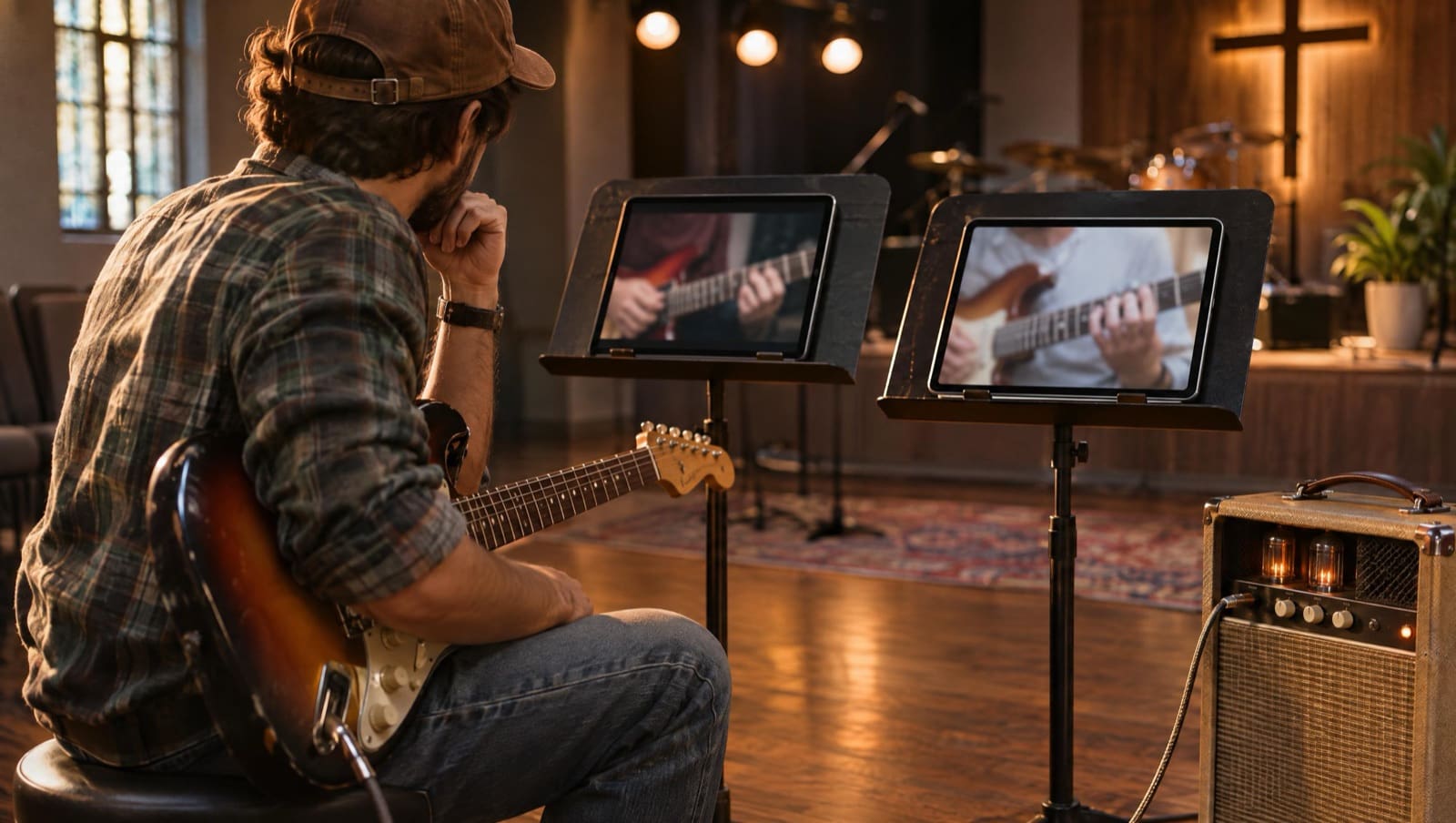
Worship team training is how you turn a group of volunteers into a band that is ready on Sunday. The step that matters most happens before rehearsal: each person learns their own part at home. Then rehearsal can train the band, instead of teaching the song.
This guide gives you a weekly plan built around that step. It also covers what to train each month, how to bring new volunteers in, and how to keep growing as the leader. You can use all of it without paying for anything.
Worship Online publishes this guide, and it gives each person what they need for that step. Each player opens their own lesson for their part, then practices it with a mixer in Sunday’s key. More than 9,000 worship teams use it. See it with a free, no-risk 14-day trial.
Or look first: the demo song, Holy Forever, opens without an account, with its part lessons and mixer.
Key Takeaways
- Worship team training has four layers: parts, band skills, heart and culture, and leadership. Many teams stall on the first one.
- Parts are learned at home. Rehearsal is for what only a room can teach: listening, dynamics, transitions and timing.
- A simple weekly rhythm works for any team size: assign every part, everyone learns their own, check in, rehearse, review.
- Train one band skill a month, and give new volunteers a 30-day plan instead of throwing them into a full set.
- On Worship Online, you assign each part on the setlist, each person opens their own lesson and practices in Sunday’s key, and you can see when each person last logged in.
In this guide:
- The four layers of training
- The weekly rhythm
- Step 1: Assign every part, not just the song
- Step 2: Everyone learns their own part before rehearsal
- Step 3: Check in before rehearsal, not at it
- Step 4: Use rehearsal to train the band
- Step 5: Train one band skill a month
- Training new volunteers: the first 30 days
- Training the heart, not just the hands
- Choosing training resources
- Training yourself as the leader
- Frequently asked questions
What Worship Team Training Covers
Worship team training can mean four different things. Each one happens in a different place.
| Layer | What it means | Where it happens | How often |
|---|---|---|---|
| Parts | Each person knows their own part, in Sunday’s key | At home, before rehearsal | Every week |
| Band skills | Timing, dynamics, listening, transitions, vocal blend | At rehearsal | Every week, one focus a month |
| Heart and culture | Why you serve, and how you treat each other | Huddles, team nights, one-to-one | Every week, briefly |
| Leadership | Growing the next leaders, and growing yourself | Mentoring, courses, coaching | All year |
Here’s the trap. If people learn their parts at rehearsal, the first layer eats the whole night. There is no time left for the other three.
It’s not a talent problem. It’s a preparation problem. Fix where the parts get learned, and every other kind of training gets room to happen.
The Weekly Worship Team Training Rhythm
This is the plan in one table. It assumes a midweek rehearsal and a Sunday service. If you rehearse on Sunday morning, move every step up a day or two. The order matters more than the days: assign, learn, check in, rehearse, review.
| When | The leader | Each musician and singer |
|---|---|---|
| Monday or Tuesday | Pick the set, set each key, assign every part, send it | Open the set and note your part and key |
| Until rehearsal | Answer questions, see who has logged in | Learn your part in two or three short sessions |
| Rehearsal | Train the band: this month’s skill, transitions, a full run-through | Play the part you already know, and listen |
| Sunday | Lead, and notice one thing to work on next | Worship instead of worrying about the next chord |
| After Sunday | Send one short note: what went well, what’s next | Read it before the next set arrives |
The rest of this guide walks through each step. For running the rehearsal itself, our worship rehearsal tips go deeper.
Step 1: Assign Every Part, Not Just the Song
A song title is not an assignment. Send two electric players the same recording and both will learn the loudest guitar. Your second keys player will copy the piano. Nobody learns the pad.
So name the part. Take Holy Forever by Chris Tomlin. On Worship Online it has seven separate instrument lessons: Electric 1, Electric 2, Acoustic, Bass, Main Keys, Aux Keys and Drums. Its vocals have separate tenor and soprano parts. That’s a lot of different jobs inside one song.
Whatever tool you use, every assignment needs four things:
- The song and the version. Which recording are you following?
- The key and tempo for Sunday. Not the key on the record, if you’ve moved it.
- Each person’s part. “Electric 2” or “alto harmony”, not “guitar” or “vocals”.
- When it’s due. The rehearsal date and time.
How Worship Online handles this step. On a team setlist (part of every team plan), you add each person and give them a role: Electric 1, Electric 2, Bass, Drums, Main Keys, Aux Keys, Lead, Tenor, Alto or Soprano vocals, and other parts the song has. You set each song’s key, add rehearsal and service times, and write notes.
When you publish the set, everyone on it gets an email and an in-app notification. No group text. No follow-up asking who plays what.
Step 2: Everyone Learns Their Own Part Before Rehearsal
This is the center of the whole plan.
Rehearsal is the one time the whole band is in one room. Every minute spent teaching one person their part costs everyone else that minute. Parts are individual work. Do individual work at home, and save shared time for shared work.
What “learned” means
Give your team one standard, so nobody has to guess what you expect. Before rehearsal, each person should be able to:
- Play or sing the part from start to finish without stopping
- Follow the song map: how many choruses, where the bridge builds, how it ends
- Do it in Sunday’s key, not the key on the recording
- Know where they come in and where they drop out
That bar is reachable for a volunteer with a job and a family. The standard is ready to rehearse, not perfect.
How to practice a part, with any resource
- Listen once for the map. Don’t chase notes yet. Count the sections.
- Isolate your part. This is the hard bit if all you have is the full recording. Your electric 2 line is buried under three other instruments.
- Loop the hardest few bars. Slow them down, then bring them back up to tempo.
- Play along with the whole song in Sunday’s key. This is where you find out whether you really know it.
- Spread it out. Plan two or three short sessions on different days, not one long one the night before.
Where Worship Online helps with this step
Isolating, looping and playing along in key are where volunteers often lose an evening. Here’s what each person does on Worship Online instead, using Holy Forever by Chris Tomlin as the example. It’s the demo song linked from Worship Online’s home page.
- Open your own lesson. On Holy Forever, that’s Electric 1, Electric 2, Acoustic, Bass, Main Keys, Aux Keys or Drums, plus tenor and soprano vocal parts. Every instrument part comes with a detailed walkthrough and a real-time demo.
- Solo your track, then mute it. The mixer has a separate track for each instrument and vocal, plus a click and a guide. Solo your part to hear it clearly. Then mute it and play along with the rest of the band.
- Practice in Sunday’s key. Worship Online lists Holy Forever in Db. If your leader moved it to C, set the mixer to transpose down one semitone. Chord charts and guitar and bass tabs change key too.
- Loop and slow down. Loop any section of a lesson video, and slow the playback until your hands catch up.
- Do it on your phone. The mixer works in the iPhone, iPad and Android apps, as well as on a computer.
Good to know: you learn the part from the lesson video, which is in the original key, then practice it in your key with the mixer, chart and tabs.
Is it the real part? The lessons are built to match the original recording, and the instructors have played for artists including Elevation Worship, Bethel, Kari Jobe, Lauren Daigle and Chris Tomlin.
One App Store reviewer describes the change this way: “Instead of getting the band together, now I can play along with any specific other part”.
Want every person on your team to have their part like this before your next rehearsal? Start a free, no-risk 14-day trial and send this week’s set from it.
Step 3: Check In Before Rehearsal, Not At It
Finding out at rehearsal that someone didn’t prepare is too late. Find out two days before, while there’s still time to help.
Skip the group text that asks “has everyone practiced?” It reads as a test, and the people who are behind go quiet. Send one short personal message instead: “Do you have everything you need for Electric 2 this week?” Ask about resources, not effort. The answer usually tells you what’s really in the way.
How Worship Online helps here. Your Team page shows each member’s last login, their instruments, and the set lists they’re in. You can filter by instrument, group or access level. Be clear with yourself about what this shows: a login means someone opened Worship Online, not that they practiced. Use it to see who might need that personal message first.
If preparation is the problem you keep hitting, our guide on how to get your worship team to practice covers the motivation side in detail.
Step 4: Use Rehearsal to Train the Band
When parts are learned at home, rehearsal changes job. You stop reteaching and start real worship band training: the things that only happen when everyone plays together.
- Listening. Who carries this section, and who gets out of the way?
- Dynamics. Where the song builds, and where the whole band pulls back.
- Transitions. The last chorus of one song into the first bar of the next.
- Timing. Locking to a click, or to the drummer.
- Vocal blend. Matching vowels, cut-offs and breaths.
Pick one of these as the focus for the night, from your monthly plan below. Finish with a full run-through of the set, top to bottom, without stopping.
Step 5: Train One Band Skill a Month
Weekly preparation keeps you ready for Sunday. A monthly focus makes the band better over time. Pick one skill, give it ten minutes at every rehearsal for a month, and give people a matching thing to try at home.
| Month | Skill | At rehearsal | At home |
|---|---|---|---|
| 1 | Time | Run one song with a click in everyone’s ears | Practice your part against a click |
| 2 | Dynamics | Play one chorus at three different levels | Mark where your part gets bigger and smaller |
| 3 | Space | Name who leads each section; everyone else thins out | Listen to the recording for one instrument at a time |
| 4 | Vocal blend | Sing harmonies with no band, then bring the band in | Sing your harmony against the lead line |
| 5 | Transitions | Rehearse only the joins between songs | Learn the last section of one song and the first of the next |
| 6 | Open moments | Hold a simple chord loop under a prayer or a reading | Learn the song’s chords as numbers, so any key feels familiar |
After six months, start again with harder songs. On Worship Online, the home column gets easier: the mixer has a click track and a separate track for each instrument and vocal, and chord charts can switch to numbers.
Training New Volunteers: The First 30 Days
A first month that feels like a test nobody studied for can lose you a new volunteer. Give them a plan instead.
- Week 1: Songs you already play. Give them two or three songs from your regular list, not this month’s new one.
- Week 2: A partner. Pair them with someone who plays the same instrument. One phone call before rehearsal is enough.
- Week 3: A supporting part. Give them the part with more room in it, not the lead line.
- Week 4: Their first full set. Same weekly rhythm as everyone else. Same standard.
The first impression starts before any of this. On the Worship Online Podcast, host Keith Elgin argues that worship team auditions are not American Idol: the audition is the first thing that shows someone what kind of team they’re joining.
Worship Online’s own guide to getting your team to use it adds one idea worth borrowing whatever tool you use: a weekly “captain” who checks that everyone has the right songs and helps anyone who’s stuck. It spreads the load, and it trains future leaders.
On Worship Online, you invite each new person with their own login and give them the Musician/Vocalist access level. That gives them the learning tools and videos, without team management. Add their instruments and a group, and they’re ready for their first set.
Training the Heart, Not Just the Hands
Musical training without culture can build a tight band that doesn’t last. Three ideas from recent Worship Online Podcast episodes are worth bringing to your team.
Preparation is part of worship. Chelsea Plank and Austin Shuffit lead SEU Worship, a campus team that rebuilds itself as students graduate. In their episode, they frame excellence as “prepare the offering”: a holy practice, not a performance standard. That changes how practicing at home feels: it becomes part of what the team brings, not homework for the leader.
Culture is built Monday through Saturday. In another episode, Keith Elgin makes the case that Sunday reveals a team’s culture rather than creating it. Preparation, communication and formation happen during the week, or not at all.
Celebrate out loud. Jordan Howerton of CCV Music, who helps lead worship across 18 campuses, talks in his episode about the jealousy and comparison that can grow on a team of gifted people. His answer is celebration, practiced out loud at every huddle. Try opening your next pre-service huddle by naming one thing a teammate did well last week.
Choosing Worship Team Training Resources
Search for worship team training resources and you’ll find three kinds. Free articles and videos teach ideas. Courses and schools, much of what you’ll find under worship training online, mostly focus on leading. Part-by-part tutorials focus on each player’s part in the songs you’re doing this month. They solve different layers, and most teams need more than one.
For the weekly step, the one this guide is built around, ask these questions of any resource:
- Does it teach each person’s part, or the song in general?
- Can each person practice it in your key?
- Does each person get their own login, so you’re not sharing a password?
- Can you see who has logged in?
- Will volunteers use it on their phone, on a lunch break?
- What does it cost per person?
“Can’t they find this on YouTube?” For a lot of songs, they can find something. The cost is the search, the cover that doesn’t match the recording, and the key that doesn’t match Sunday. For one song a month, that may be fine. For a whole team every week, it adds up to hours nobody has.
“Will my volunteers actually use it?” Worship Online’s team guide quotes Kendrick, a worship leader in Kingsport, TN, on his keyboard player: “There was some resistance at first, especially from the keyboard player (he has a great ear) but even he loves it now.”
What it costs. On November 12, 2026, Worship Online’s team plans ran from $37 a month for up to 5 members ($7.40 each) to $132 a month for up to 35 ($3.77 each). Every team plan includes every tutorial, chart and team tool, and annual billing costs 25% less. See the pricing page for every plan.
If you’re weighing options, we also compare worship music learning platforms and apps for worship teams.
Training Yourself as the Leader
Worship leader training is the layer that is easiest to skip. Nobody above you schedules it, so it can quietly never happen.
Start by training trainers. SEU Worship’s episode describes five staff who develop thirty-plus student leaders, who then develop everyone else, so the discipleship isn’t sitting on one person. On a church team, that might mean one vocal lead and one band lead who each run part of the weekly check-in.
For your own growth, Worship Online also runs Lab+, its training and growth platform. Its help center lists a training library with courses on worship leadership, musicianship, healthy team culture and rehearsal strategy, live coaching and workshops with replays, a community forum, and an AI coach. Lab+ has its own membership.
Frequently Asked Questions
What should worship team training include?
Four layers: each person’s parts, band skills such as timing and dynamics, heart and team culture, and leadership. Parts are learned at home every week. Band skills are trained at rehearsal, one focus at a time. Culture and leadership run alongside both.
How often should a worship team train?
Every week, in small pieces. Each person learns their part before rehearsal, and rehearsal trains one band skill for about ten minutes. Change the skill each month. Add a longer team night a few times a year if you can.
How do you train a worship team with mixed skill levels?
Match the part to the player. Songs with separate parts, such as Electric 1 and Electric 2 or Main Keys and Aux Keys, let you give a newer player the part with more room in it. Hold everyone to the same “ready to rehearse” standard, whatever part they have.
Is there free worship team training?
Yes. Everything in this guide is free to use, and the Worship Online Podcast is free to listen to. A paid tool saves the time it takes to find, isolate and transpose each part.
Can volunteers train on their phones?
On Worship Online, yes. There are apps for iPhone, iPad and Android, and the mixer works in them. The apps need an active Worship Online subscription.
Do Worship Online’s video lessons change key?
No. The video lessons are in the original key. The mixer audio, chord charts and guitar and bass tabs change to any key, so each person learns the part from the lesson and practices it in Sunday’s key. Here’s how key changes work.
Start Your Worship Team Training This Week
You don’t need a bigger team or a longer rehearsal. You need the parts learned before anyone walks in. Assign every part. Give people a clear standard and a way to practice. Check in early. Then use rehearsal to train the band.
Here’s what that looks like inside Worship Online:
Start your free, no-risk 14-day trial of Worship Online. Build this week’s set and give each person the part the song has for them, from Electric 2 to a harmony line. Each one opens their own lesson, practices it in the mixer in Sunday’s key, and walks in ready to rehearse. Before rehearsal, you can see who has logged in.
You get tutorials for 800+ songs, on a platform more than 9,000 worship teams use. Rehearsal stops being about learning the song and starts being about leading worship.